Guitar chords
Find any guitar chord by its name and see it as a chord diagram. Each chord comes with every common way to hold it, from the open shape to the barre chords higher up the neck, with its notes and its inversions, in standard tuning, Drop D, Drop C, Drop B and DADGAD. Hear any of them in the TabTunix app.
Show
X 3 2 0 1 0
Notes
Degrees: R 3 5. Notes: C E G.
Inversions
Voicings
Major
Minor
Suspended
Power Chords
Intermediate adds the sixths, added ninths and sevenths. Advanced shows every chord on the root.
Guitar chord chart: the chords to learn first
Most songs you meet first are built from eight open chords: C, A, G, E, D, Am, Em and Dm. They sit in the first three frets and share fingers, so the changes between them are short: from C to Am only your ring finger moves, and Am is the shape of E moved over by one string.
Then come the two that stop most beginners, F and Bm, the first barre chords. Your index finger lies across the strings at one fret, and the other fingers hold the shape of E, or of Am, above it.
To keep the chart beside your guitar, print this page: the chart alone goes onto the sheet, and your browser's print dialog can save it as a PDF.
- C
X 3 2 0 1 0 - A
X 0 2 2 2 0 - G
3 2 0 0 0 3 - E
0 2 2 1 0 0 - D
X X 0 2 3 2 - Am
X 0 2 2 1 0 - Em
0 2 2 0 0 0 - Dm
X X 0 2 3 1 - F
1 3 3 2 1 1 - Bm
X 2 4 4 3 2
How to read a chord diagram
A chord diagram shows the neck as it faces you when the guitar stands upright: the nut at the top, the lowest string on the left. The numbers beside this one name its parts:
- 1X: a string you do not play.
- 2O: a string you play open, with no finger on it.
- 3The thick line is the nut, the top end of the neck.
- 4The six lines down are the strings, the lowest on the left.
- 5The lines across are the frets. Your finger goes into the row between two of them.
- 6A dot is a finger on that string, in that fret. Its number is the finger: 1 index, 2 middle, 3 ring, 4 little finger.
- 7The fret the diagram starts at: 1fr here, 3fr for a chord that begins at the third fret.
A bar drawn across several strings is a barre: one finger laid flat that holds them all down, as in F.
The same chord can be written as frets: X 3 2 0 1 0. That is one sign for each string, from the lowest to the highest: X for a string you do not play, 0 for an open string, else the fret you hold.
Chord types and what they are made of
A chord's name is a root and a type: in F#m7, F# is the root and m7 the type. The type says which notes are stacked on the root, counted as degrees: R is the root, 3 the third, 5 the fifth, and a b lowers a note by a semitone. The library sorts its 42 types into 8 groups.
Which chords belong together in a song is a matter of the key: the chords of any key are these types on the notes of its scale.
| Type | Symbol | Formula | Notes on C |
|---|---|---|---|
| Major | C | R 3 5 | C E G |
| Minor | Cm | R b3 5 | C Eb G |
| Seventh | C7 | R 3 5 b7 | C E G Bb |
| Major Seventh | Cmaj7 | R 3 5 7 | C E G B |
| Minor Seventh | Cm7 | R b3 5 b7 | C Eb G Bb |
| Suspended | Csus4 | R 4 5 | C F G |
| Power Chords | C5 | R 5 | C G |
| Diminished & Augmented | Cdim | R b3 b5 | C Eb Gb |
Major
A major chord is the root, the third and the fifth: R 3 5. Nothing follows the letter in its name. A 6 or an add9 is the same chord with one note more: R 3 5 6 and R 3 5 9.
Minor
Lower the third by a semitone and the chord is minor: R b3 5. It is written with a small m after the letter.
Seventh
A seventh chord is a major chord with a fourth note, the minor seventh: R 3 5 b7. It is written with a 7 alone. The ninth, eleventh and thirteenth chords of this group stack more notes on top: a 9 is R 3 5 b7 9.
Major Seventh
A major seventh chord takes the seventh that lies a semitone under the root: R 3 5 7, written maj7.
Minor Seventh
A minor chord with the minor seventh: R b3 5 b7, written m7. Lower its fifth as well and it is the half-diminished chord, m7b5: R b3 b5 b7.
Suspended
A suspended chord has no third. Sus4 puts the fourth in its place (R 4 5), sus2 the second (R 2 5), so the chord is neither major nor minor.
Power Chords
A power chord is the root and the fifth alone, R 5, on two or three strings. With no third it is neither major nor minor, which is why it works with distortion.
Diminished & Augmented
A diminished chord is a minor chord with its fifth lowered: R b3 b5. A diminished seventh adds one note more (R b3 b5 bb7), and an augmented chord is a major chord with its fifth raised (R 3 #5).
Open chords, barre chords and movable shapes
An open chord uses open strings and sits at the nut, as E does.
A barre chord holds several strings with one finger, and it moves. F is the shape of E one fret higher, with your index finger across all six strings where the nut was. Slide the same shape up one more fret and it is F#, and at fret 3 it is G: each fret is a semitone. That is why learning F gives you F#, G and the rest.
The library puts the open shape first where a chord has a common one, and else the barre or movable shape that lies lowest on the neck.
One chord, many shapes: voicings and inversions
A voicing is one way to hold a chord. The same notes lie in several places on the neck, so G is the open shape, a barre at fret 3, and more shapes higher up. In the library every chord shows up to six voicings, from low on the neck to high.
An inversion puts another note of the chord in the bass. It is written with a slash: C/E is C over its third, E. With First, Second and Third the library shows a chord over its third, its fifth and, where it has one, its seventh. A chord with no third to turn on, as a sus or a power chord, has none.
The notes of a chord come from a scale, which is where chords and guitar scales meet.
- G
3 2 0 0 0 3 - G
3 5 5 4 3 3 - G
X X 5 7 8 7 - G
X 10 9 7 8 7 - G
X 10 12 12 12 10 - G
15 14 12 12 12 15
Chords in Drop D, Drop C, Drop B and DADGAD
Most chord charts are written for standard tuning. Change the tuning in the library and every chord is drawn in it.
In Drop D only the lowest string moves, so only the shapes that use it change: D gains its open low string, C and Am stay as they are, and a power chord lies on one fret across the three lowest strings. Drop C and Drop B are Drop D tuned lower: every string moves, so every chord sits elsewhere on the neck. In DADGAD three strings are tuned down, and the library finds each chord's shapes for it.
These are the five guitar tunings of the app's Chords screen.
All guitar chords, by root
All 504 chords of the library, a type at a time and from C to B. Pick one, and the library at the top of this page opens on it.
Major
Minor
Seventh
- C7
- C9
- C7#9
- C11
- C13
- C7sus4
- C7b5
- C7#5
- C7b9
- C9b5
- C9#5
- C9#11
- C#7
- C#9
- C#7#9
- C#11
- C#13
- C#7sus4
- C#7b5
- C#7#5
- C#7b9
- C#9b5
- C#9#5
- C#9#11
- D7
- D9
- D7#9
- D11
- D13
- D7sus4
- D7b5
- D7#5
- D7b9
- D9b5
- D9#5
- D9#11
- Eb7
- Eb9
- Eb7#9
- Eb11
- Eb13
- Eb7sus4
- Eb7b5
- Eb7#5
- Eb7b9
- Eb9b5
- Eb9#5
- Eb9#11
- E7
- E9
- E7#9
- E11
- E13
- E7sus4
- E7b5
- E7#5
- E7b9
- E9b5
- E9#5
- E9#11
- F7
- F9
- F7#9
- F11
- F13
- F7sus4
- F7b5
- F7#5
- F7b9
- F9b5
- F9#5
- F9#11
- F#7
- F#9
- F#7#9
- F#11
- F#13
- F#7sus4
- F#7b5
- F#7#5
- F#7b9
- F#9b5
- F#9#5
- F#9#11
- G7
- G9
- G7#9
- G11
- G13
- G7sus4
- G7b5
- G7#5
- G7b9
- G9b5
- G9#5
- G9#11
- Ab7
- Ab9
- Ab7#9
- Ab11
- Ab13
- Ab7sus4
- Ab7b5
- Ab7#5
- Ab7b9
- Ab9b5
- Ab9#5
- Ab9#11
- A7
- A9
- A7#9
- A11
- A13
- A7sus4
- A7b5
- A7#5
- A7b9
- A9b5
- A9#5
- A9#11
- Bb7
- Bb9
- Bb7#9
- Bb11
- Bb13
- Bb7sus4
- Bb7b5
- Bb7#5
- Bb7b9
- Bb9b5
- Bb9#5
- Bb9#11
- B7
- B9
- B7#9
- B11
- B13
- B7sus4
- B7b5
- B7#5
- B7b9
- B9b5
- B9#5
- B9#11
Major Seventh
- Cmaj7
- Cmaj9
- Cmaj11
- Cmaj13
- Cmaj7b5
- Cmaj7#5
- Cmaj7sus2
- C#maj7
- C#maj9
- C#maj11
- C#maj13
- C#maj7b5
- C#maj7#5
- C#maj7sus2
- Dmaj7
- Dmaj9
- Dmaj11
- Dmaj13
- Dmaj7b5
- Dmaj7#5
- Dmaj7sus2
- Ebmaj7
- Ebmaj9
- Ebmaj11
- Ebmaj13
- Ebmaj7b5
- Ebmaj7#5
- Ebmaj7sus2
- Emaj7
- Emaj9
- Emaj11
- Emaj13
- Emaj7b5
- Emaj7#5
- Emaj7sus2
- Fmaj7
- Fmaj9
- Fmaj11
- Fmaj13
- Fmaj7b5
- Fmaj7#5
- Fmaj7sus2
- F#maj7
- F#maj9
- F#maj11
- F#maj13
- F#maj7b5
- F#maj7#5
- F#maj7sus2
- Gmaj7
- Gmaj9
- Gmaj11
- Gmaj13
- Gmaj7b5
- Gmaj7#5
- Gmaj7sus2
- Abmaj7
- Abmaj9
- Abmaj11
- Abmaj13
- Abmaj7b5
- Abmaj7#5
- Abmaj7sus2
- Amaj7
- Amaj9
- Amaj11
- Amaj13
- Amaj7b5
- Amaj7#5
- Amaj7sus2
- Bbmaj7
- Bbmaj9
- Bbmaj11
- Bbmaj13
- Bbmaj7b5
- Bbmaj7#5
- Bbmaj7sus2
- Bmaj7
- Bmaj9
- Bmaj11
- Bmaj13
- Bmaj7b5
- Bmaj7#5
- Bmaj7sus2
Minor Seventh
- Cm7
- Cm7b5
- Cm9
- Cm11
- Cm(maj7)
- Cm(maj9)
- Cm(maj11)
- Cm(maj7)b5
- C#m7
- C#m7b5
- C#m9
- C#m11
- C#m(maj7)
- C#m(maj9)
- C#m(maj11)
- C#m(maj7)b5
- Dm7
- Dm7b5
- Dm9
- Dm11
- Dm(maj7)
- Dm(maj9)
- Dm(maj11)
- Dm(maj7)b5
- Ebm7
- Ebm7b5
- Ebm9
- Ebm11
- Ebm(maj7)
- Ebm(maj9)
- Ebm(maj11)
- Ebm(maj7)b5
- Em7
- Em7b5
- Em9
- Em11
- Em(maj7)
- Em(maj9)
- Em(maj11)
- Em(maj7)b5
- Fm7
- Fm7b5
- Fm9
- Fm11
- Fm(maj7)
- Fm(maj9)
- Fm(maj11)
- Fm(maj7)b5
- F#m7
- F#m7b5
- F#m9
- F#m11
- F#m(maj7)
- F#m(maj9)
- F#m(maj11)
- F#m(maj7)b5
- Gm7
- Gm7b5
- Gm9
- Gm11
- Gm(maj7)
- Gm(maj9)
- Gm(maj11)
- Gm(maj7)b5
- Abm7
- Abm7b5
- Abm9
- Abm11
- Abm(maj7)
- Abm(maj9)
- Abm(maj11)
- Abm(maj7)b5
- Am7
- Am7b5
- Am9
- Am11
- Am(maj7)
- Am(maj9)
- Am(maj11)
- Am(maj7)b5
- Bbm7
- Bbm7b5
- Bbm9
- Bbm11
- Bbm(maj7)
- Bbm(maj9)
- Bbm(maj11)
- Bbm(maj7)b5
- Bm7
- Bm7b5
- Bm9
- Bm11
- Bm(maj7)
- Bm(maj9)
- Bm(maj11)
- Bm(maj7)b5
Suspended
In the app
From knowing a chord to changing to it in time
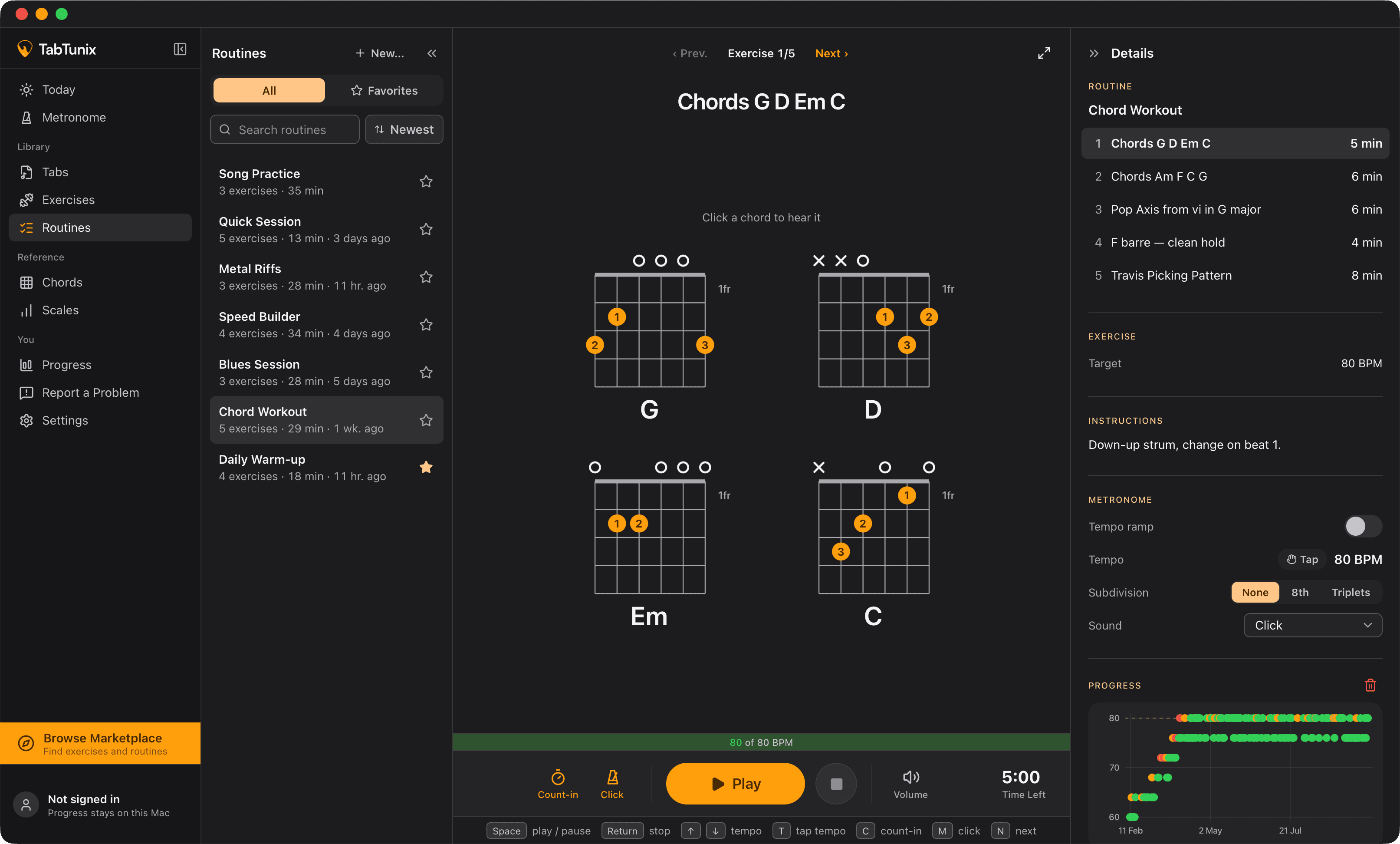
A chord is learned when you can change to it without stopping. In TabTunix you pick up to six chords, set a target tempo, and play the changes to a click that counts you through them. Rate each take, and the app keeps your best tempo, so next week you see whether you got faster.
Two things worth knowing next: how to change chords faster, and the chord progressions these chords turn up in.
Questions about guitar chords
You know which lick it is. Go get it up to tempo. Free, for Mac and Windows.
macOS 13 or newer