Phrygian scale on guitar
The Phrygian scale has the formula R b2 b3 4 5 b6 b7. In E its notes are E F G A B C D. Below you see it on the whole neck, its seven positions one by one and the chords it makes, in standard tuning or in Drop D, Drop C, Drop B and DADGAD. Check out all 13 guitar scales.
Position
- 1: frets 0 to 5, 12 to 17
- 2: frets 1 to 7, 13 to 19
- 3: frets 3 to 8, 15 to 20
- 4: frets 5 to 10, 17 to 22
- 5: frets 7 to 12
- 6: frets 8 to 13
- 7: frets 10 to 15
E Phrygian
E Phrygian is E Natural Minor with the 2 lowered by a half step.
Phrygian: degrees R b2 b3 4 5 b6 b7, notes E F G A B C D. Natural Minor: degrees R 2 b3 4 5 b6 b7, notes E F# G A B C D.
Chords
Notes and formula of the Phrygian scale
Degrees: R b2 b3 4 5 b6 b7. Notes: E F G A B C D.
Its formula is R b2 b3 4 5 b6 b7, the same in every key: learn it once and you can build the Phrygian scale on any root. Players often use it for riffs in metal and flamenco.
A root on a black key goes by one name here: C# Phrygian, never Db Phrygian. To find each note on the neck on its own, see every note on the fretboard.
How the Phrygian scale differs from E Natural Minor
E Phrygian is E Natural Minor with the 2 lowered by a half step.
Phrygian: degrees R b2 b3 4 5 b6 b7, notes E F G A B C D. Natural Minor: degrees R 2 b3 4 5 b6 b7, notes E F# G A B C D.
F is the note that makes the difference; on the neck above it wears a ring.
Phrygian scale positions on the neck
Nobody learns the whole neck at once. The Phrygian scale comes in seven boxes with three notes on each string: position 1 starts on your low string with the root, E at fret 0, and each next box starts on the next note of the scale.
Learn one box, then the next, and play across both: together they cover the neck. Where the neck has room, a box comes back twelve frets higher. These are three-notes-per-string shapes, not CAGED.
Position 1, frets 0 to 5
Position 2, frets 1 to 7
Position 3, frets 3 to 8
Position 4, frets 5 to 10
Position 5, frets 7 to 12
Position 6, frets 8 to 13
Position 7, frets 10 to 15
Scales with the same notes as the Phrygian scale
Same notes, same frets, another home note: know the Phrygian scale on the neck and you already have these under your fingers.
All seven modes side by side: guitar modes.
The Phrygian scale in every key
Your song is in F#? Find its row: the notes of the Phrygian scale in that key, and the fret where your first box starts. Click the key and the neck at the top jumps there.
| Key | Notes | Position 1 from fret |
|---|---|---|
| C Phrygian scale | C Db Eb F G Ab Bb | 8 |
| C# Phrygian scale | C# D E F# G# A B | 9 |
| D Phrygian scale | D Eb F G A Bb C | 10 |
| D# Phrygian scale | D# E F# G# A# B C# | 11 |
| E Phrygian scaleon this page | E F G A B C D | 0 |
| F Phrygian scale | F Gb Ab Bb C Db Eb | 1 |
| F# Phrygian scale | F# G A B C# D E | 2 |
| G Phrygian scale | G Ab Bb C D Eb F | 3 |
| G# Phrygian scale | G# A B C# D# E F# | 4 |
| A Phrygian scale | A Bb C D E F G | 5 |
| Bb Phrygian scale | Bb B Db Eb F Gb Ab | 6 |
| B Phrygian scale | B C D E F# G A | 7 |
The Phrygian scale in Drop D, Drop C, Drop B and DADGAD
Tune down and the Phrygian scale stays the same scale, it just sits on other frets. In Drop D only your low string changes, so every shape on the other five strings stays put. Drop C and Drop B take every string down, so the whole scale shifts, and DADGAD lowers three strings. Here is where its root E sits on the low string in each.
| Tuning | E on the low string |
|---|---|
| Standard | frets 0 and 12 |
| Drop D | frets 2 and 14 |
| Drop C | frets 4 and 16 |
| Drop B | frets 5 and 17 |
| DADGAD | frets 2 and 14 |
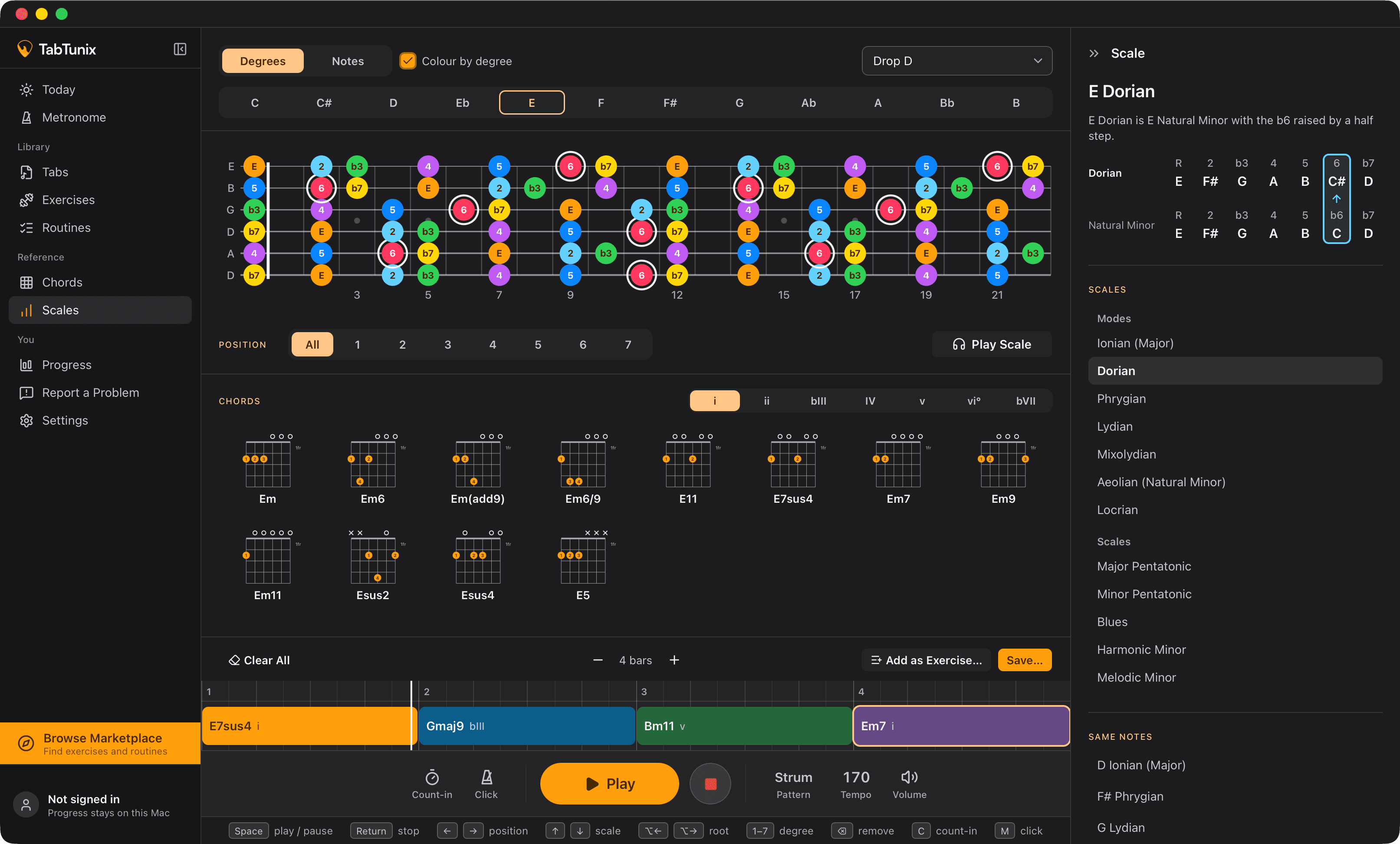
In the app
Practice the Phrygian scale
Knowing a position is half the job. Turn it into an exercise in the free TabTunix app, play it to a click that speeds up step by step, rate each go, and see on your chart how close you are to your target tempo.
More on how to get a scale under your fingers in how to practice scales, and every other scale under guitar scales.
Questions about the Phrygian scale
You know which lick it is. Go get it up to tempo. Free, for Mac and Windows.
macOS 13 or newer