Guitar scales
See any guitar scale on the whole fretboard, in any key. Pick a root and a scale, from the minor pentatonic to the seven modes, and step through its positions one box at a time, with the chords that go with it, in standard tuning, Drop D, Drop C, Drop B and DADGAD.
Position
- 1: frets 5 to 8, 17 to 20
- 2: frets 7 to 10, 19 to 22
- 3: frets 9 to 13
- 4: frets 0 to 3, 12 to 15
- 5: frets 2 to 5, 14 to 17
A Minor Pentatonic
Degrees: R b3 4 5 b7. Notes: A C D E G.
Modes
Scales
Same notes
Chords of A Aeolian (Natural Minor)
The guitar scales to learn first
You do not need all 13 scales at once. These are the guitar scales for beginners, and the ones every guitarist keeps using: five, in the order to learn them, each with its first box on A.
A Minor Pentatonic
Five notes, and a first box with two notes on each string that your hand covers without moving. Most rock and blues solos start here.
Position 1, frets 5 to 8
A Ionian (Major)
The scale keys and chords are built from. Its seven notes name a key, and its chords are the chords of that key.
Position 1, frets 5 to 10
A Aeolian (Natural Minor)
The scale of a minor key: the notes of C major, with A as home.
Position 1, frets 5 to 10
A Blues
The minor pentatonic with one note added, the b5 between the 4 and the 5. It is the sound of a blues lick.
Position 1, frets 5 to 8
A Major Pentatonic
The same shapes as the minor pentatonic, from another root: A minor pentatonic and C major pentatonic share their notes.
Position 1, frets 4 to 7
All the scales, with their formulas
All 13 scales with their formula and their notes from A. Click a name for its own page: its positions, its chords and every key. Print this page and you get the table on one sheet; your print dialog can also save it as a PDF.
| Scale | Formula | Notes from A | Used for |
|---|---|---|---|
| Ionian (Major) | R 2 3 4 5 6 7 | A B C# D E F# G# | Pop, rock and folk melodies |
| Dorian | R 2 b3 4 5 6 b7 | A B C D E F# G | Minor grooves in funk, rock and jazz |
| Phrygian | R b2 b3 4 5 b6 b7 | A Bb C D E F G | Riffs in metal and flamenco |
| Lydian | R 2 3 #4 5 6 7 | A B C# D# E F# G# | Melodies in film music |
| Mixolydian | R 2 3 4 5 6 b7 | A B C# D E F# G | Rock and blues riffs over major chords |
| Aeolian (Natural Minor) | R 2 b3 4 5 b6 b7 | A B C D E F G | Minor-key songs in rock, pop and metal |
| Locrian | R b2 b3 4 b5 b6 b7 | A Bb C D Eb F G | Metal riffs |
| Major Pentatonic | R 2 3 5 6 | A B C# E F# | Country, pop and major-key solos |
| Minor Pentatonic | R b3 4 5 b7 | A C D E G | Rock and blues solos |
| Blues | R b3 4 b5 5 b7 | A C D Eb E G | Blues and rock licks |
| Harmonic Minor | R 2 b3 4 5 b6 7 | A B C D E F G# | Neoclassical metal and minor-key melodies |
| Melodic Minor | R 2 b3 4 5 6 7 | A B C D E F# G# | Jazz lines over minor chords |
| Phrygian Dominant | R b2 3 4 5 b6 b7 | A Bb C# D E F G | Metal, flamenco and Middle Eastern music |
How to read a scale on the fretboard
The fretboard shows the neck as you see it when you look down at the guitar in your lap: the lowest string at the bottom, the nut at the left. The numbers on this one name its parts:
- 1The six lines are the strings, the lowest at the bottom, each named at the left.
- 2A dot is a note of the scale, with its name in it.
- 3The amber dots are the root, the note the scale is named after: A.
- 4The numbers under the neck name the frets with inlay marks, the gray dots between the strings.
Switch the dots from Notes to Degrees and each dot says what its note does in the scale: R is the root, b3 the minor third, 5 the fifth. The degrees stay the same in every key, so a shape you learn on A works on any root. Where each note lies on its own is every note on the fretboard.
Positions: one box at a time
Nobody learns the whole neck at once. You learn a scale in positions, boxes of a few frets at one place on the neck. A pentatonic scale has five boxes with two notes on each string; a seven-note scale has seven shapes with three notes on each string.
Each box starts on the next note of the scale. In a pentatonic the higher note of one box on each string is the lower note of the next, so the boxes join up the neck: below are the five of A minor pentatonic, each where the one before ends. Learn one, then its neighbor, then play across both.
The shapes of a seven-note scale here are three notes per string, made by one rule in every tuning: each tuning gets its own shapes from it.
Position 1, frets 5 to 8
Position 2, frets 7 to 10
Position 3, frets 9 to 13
Position 4, frets 12 to 15
Position 5, frets 14 to 17
Modes: the same notes from another root
The seven modes are the major scale started on each of its notes. D Dorian has the notes of C major; what changes is which note is home, and with it how every other note sounds against it. So one shape on the neck gives you seven modes, each with another home note. More on each of them under guitar modes.
Scales and chords belong together
Stack every other note of a scale and you get its chords: A, C and E of A natural minor make Am. Under the neck you get the chords on every note of the scale as chord shapes, and for a pentatonic the chords of the key you play it in. That is also the answer to which chords are in a key: see chords in a key, and every shape of each chord under guitar chords.
Scales in Drop D, Drop C, Drop B and DADGAD
Tune down and the scale moves with your strings. In Drop D only your low string drops, two frets: every shape on the other five strings stays. Drop C and Drop B take every string lower, so the whole scale shifts along the neck. DADGAD lowers three strings, and every scale gets boxes of its own for it.
In the app
From seeing a scale to playing it
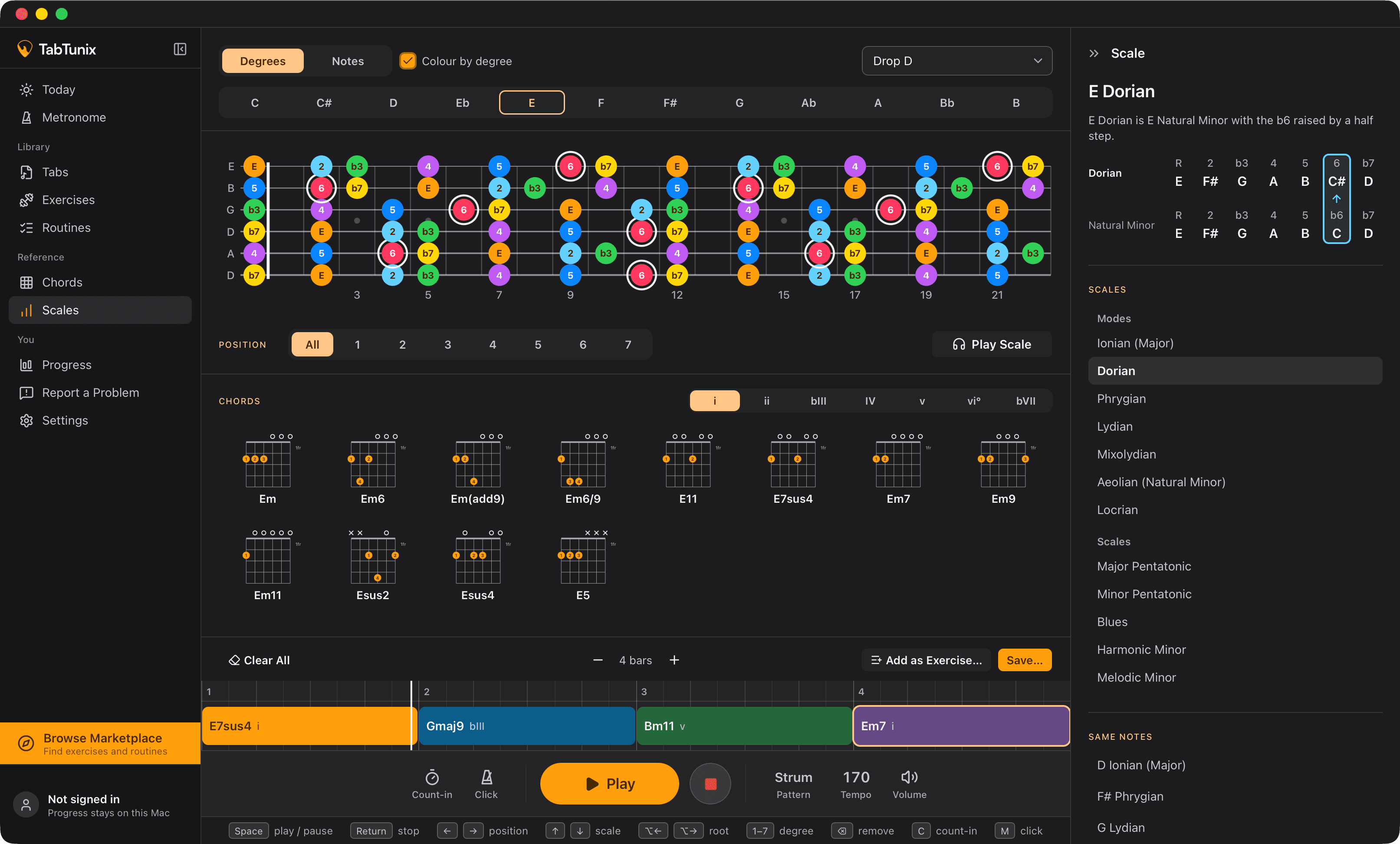
A scale is learned at a tempo: start slow enough to play it clean, then speed up in small steps. In the free TabTunix app you hear any scale, turn it into an exercise with a target tempo, play it to a click, rate each go and see your best tempo climb.
More on how to get a scale under your fingers in how to practice scales.
Questions about guitar scales
You know which lick it is. Go get it up to tempo. Free, for Mac and Windows.
macOS 13 or newer