Guitar chord progressions
Guitar chord progressions in any key: 25 well-known ones, from the 12-bar blues to Pachelbel's Canon, every chord drawn as a diagram. Written in Roman numerals, a progression fits every key: I – V – vi – IV is G D Em C in G major and C G Am F in C major.
Pop Axis in G major
MajorI – V – vi – IV
G D Em C
Heard in “Let It Be” by The Beatles
Standard tuning: E A D G B E
Key
Tuning
Chart
- Bar 1: GI
- Bar 2: DV
- Bar 3: Emvi
- Bar 4: CIV
Chords
Sad or happy: what each progression sounds like
To most ears raised on Western music, a minor chord sounds sadder than a major one, so a progression takes much of its mood from its minor chords and from the chord it comes home to. These are the moods most guitarists hear in them:
- Sad, or bittersweet: the Pop Axis from vi and the Aeolian Descent start on the minor chord. Both are the four chords of the Pop Axis, Am F C G in C, which can be heard as major or as minor. In the Major to Minor Four the IV turns minor: G B C Cm.
- A lament: the Andalusian Cadence, Am G F E. Its falling bass carried the laments of 17th-century opera, and its name comes from flamenco.
- Bright: the Three-Chord Song and the I–IV–V–IV: major chords only, built around the I.
- Doo-wop: the 50s Progression, the ballad sound of the 1950s.
- Heartrending: the Royal Road, the progression of J-pop.
- Funky minor: the Dorian Vamp, a minor chord and a major IV, at home in funk and in “Oye Como Va”.
- Rock: the Mixolydian Vamp and the Aeolian Vamp lean on the major chord a whole step under the root.
- Bluesy: the 12-Bar Blues, the Quick-Change Blues, the 8-Bar Blues and the Minor Blues.
The chords only start it: tempo, melody and how you strum decide as much, and a progression from a happy song can carry a sad one.
Chord progression Roman numerals: what I, IV and V mean
A numeral names a chord by its place in the key. Count up the key's scale from its first note: I is the chord on the first note, IV the chord on the fourth, V the chord on the fifth. Upper case is a major chord, lower case a minor one, and what follows the numeral says what kind of chord it is:
| Numeral | What it is | In C major |
|---|---|---|
| I | the major chord on the key's first note | C |
| vi | the minor chord on the sixth note | Am |
| bVII | a major chord a half step under the seventh note | Bb |
| V7 | a seventh chord on the fifth note | G7 |
| ii7 | a minor seventh chord on the second note | Dm7 |
| Imaj7 | a major seventh chord on the first note | Cmaj7 |
| iiø7 | a half-diminished seventh chord on the second note | Dm7b5 |
In a minor key the numerals count the same places of the major scale, so its lower third, sixth and seventh carry a b: the Andalusian Cadence reads i – bVII – bVI – V, Am G F E in A minor. Some books leave the b out: i – VII – VI – V. The numerals stay the same in every key; only the chords move:
| Key | I | V | vi | IV |
|---|---|---|---|---|
| G major | G | D | Em | C |
| E major | E | B | C#m | A |
| F major | F | C | Dm | Bb |
The Nashville number system counts the same places in digits, a minus marking a minor chord: I – IV – V is 1 4 5, and the Pop Axis, I – V – vi – IV, is 1 5 6- 4, the progression people call the four-chord song.
Any progression in any key
A major progression comes in all twelve major keys, a minor one in all twelve minor keys, and every chord is spelled as its key spells it: in F major the IV is Bb, not A#. If you are starting out, use the key listed with each progression: 17 of the 25 need no barre chord there, as the 12-Bar Blues in A major, with A7, D7 and E7.
Tuned to Drop D, Drop C, Drop B or DADGAD? Every chord comes with its shape for that tuning, so you can play along without retuning. Every other way to hold a chord is under guitar chords.
How to practice a chord progression
- Pick a progression and learn its chords from the diagrams first.
- Play it to a click, slow enough that every change lands before the next bar begins. The metronome gives you the click.
- Strum once on each chord, then on every beat, then pick each chord's notes one by one.
- Raise the tempo a little each time you get through without a stop.
- Move it to another key: the numerals stay, the shapes change.
One change that keeps tripping you up is worth practicing on its own, slowly, back and forth: that is how to change chords faster.
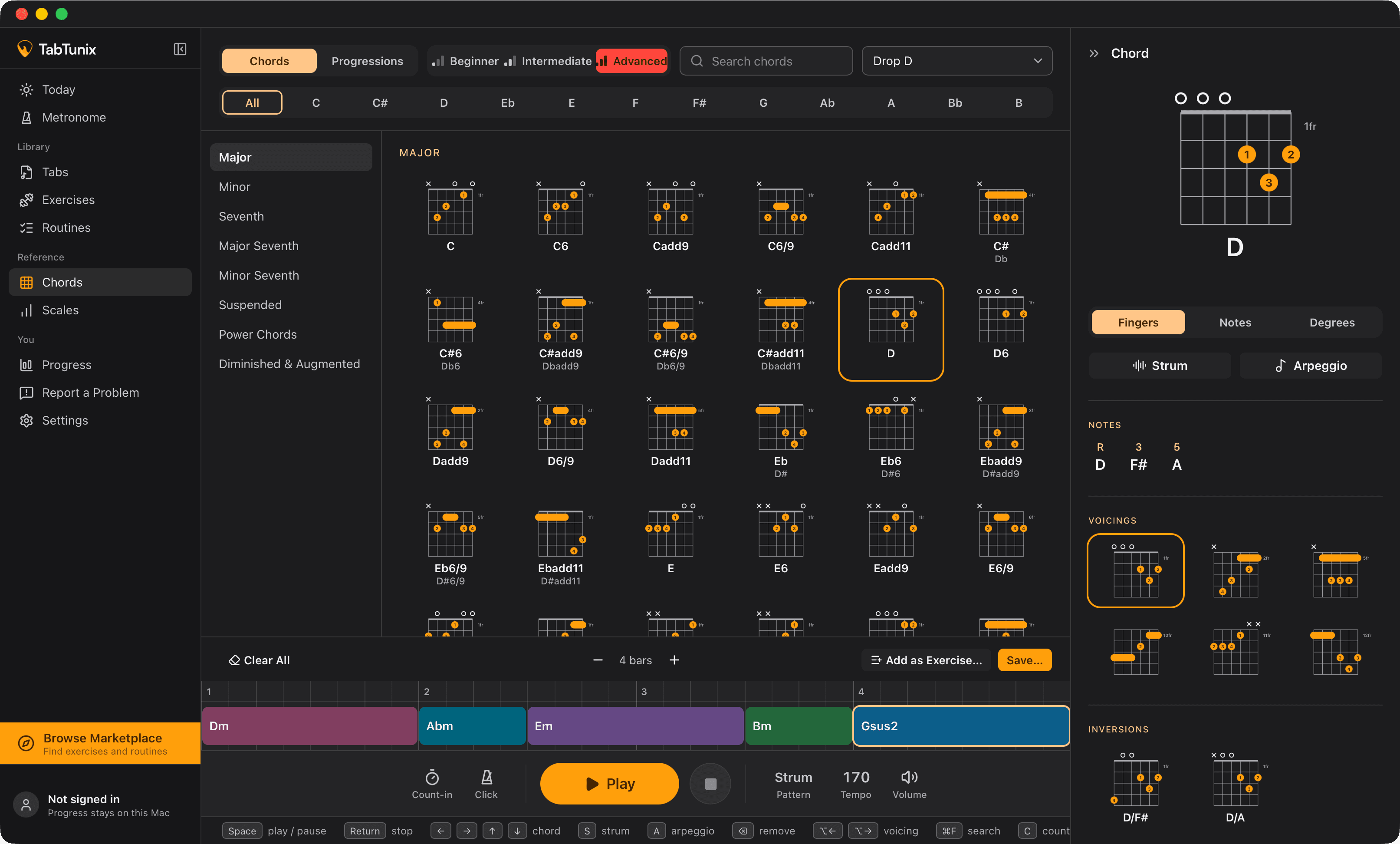
In TabTunix you play along with the progression on a loop, from as slow as 40 BPM and faster as the changes come clean, strummed or picked note by note. Make it an exercise with a tempo to reach, rate each go, and see on a chart how close you are. Your own progressions, written from any chords, practice the same way.
Questions about guitar chord progressions
Play it at your tempo until the changes are yours. Free, for Mac and Windows.
macOS 13 or newer