Guitar practice routine for 15, 30 or 60 minutes

By TabTunix · Published

A good guitar practice routine gives every minute a job: a short warm-up, one technique, the chord changes or the scale you are working on, and a song to finish. In 30 minutes that is six blocks of five, each with a goal you can check. Play the same routine for a week before you change it.

Three guitar practice routines: 15, 30 and 60 minutes

Pick the routine that fits the time you have each day and play it as it stands; every block says when it is done, so you know when to move on. Take the two chords from a song you are learning or from the guitar chord chart, a progression from the common chord progressions, and the scale from the guitar scales. Start with the minor pentatonic, the scale most guitarists learn first. Printed, all three routines fit on one sheet.

15-minute routine

For a beginner, or a day with little time.

The 15-minute routine: the minutes of each block, what to play, and when it is done
MinutesWhat to play, and when it is done
3 minWarm-up: a finger exerciseDone when: Every note even, at a tempo you can hold
4 minChord changes between two chordsDone when: Four clean changes in a row, each on the beat
4 minOne scale in one positionDone when: Up and down to a click without a stop
4 minA song or a riffDone when: Through once without stopping

30-minute routine

For most days, once you know a few chords.

The 30-minute routine: the minutes of each block, what to play, and when it is done
MinutesWhat to play, and when it is done
5 minWarm-up: a finger exerciseDone when: Every note even, at a tempo you can hold
5 minTechnique: pickingDone when: Clean at your last best tempo, then a few BPM up
5 minChord changesDone when: Four clean changes in a row, each on the beat
5 minA scale in two positionsDone when: From one position into the next without a gap
5 minThe hard bars of a song, loopedDone when: Three clean loops in a row
5 minThe song, played throughDone when: Through once, mistakes and all

60-minute routine

For an intermediate player moving up a level, in one session or two.

The 60-minute routine: the minutes of each block, what to play, and when it is done
MinutesWhat to play, and when it is done
5 minWarm-up: a finger exerciseDone when: Every note even, at a tempo you can hold
10 minTechnique one, such as alternate pickingDone when: Your best clean tempo, written down
10 minTechnique two, such as legato or bendsDone when: Your best clean tempo, written down
10 minChord changes or a progressionDone when: Four clean changes in a row, each on the beat
10 minA scale across the whole neckDone when: From its lowest note to its highest without stopping
10 minThe hard bars of a song, loopedDone when: Three clean loops, then a few BPM up
5 minPlay for funDone when: Nothing to count

How to build your own guitar practice routine

Your own routine works when it keeps four rules:

  1. Every block has one aim you can check: a tempo or a count, such as four clean changes in a row. “Work on barre chords” isn't one.
  2. The hardest thing comes early, right after the warm-up, while you are fresh.
  3. Blocks are short, ten minutes at most. Past that your attention goes, and so does the progress.
  4. It ends with music: a song, a riff, or playing for fun, so you stop on what you practice for.

To choose what you practice every day, take four things: one for the fretting hand, such as a finger exercise; one for the picking hand, such as alternate picking; one for the neck, a scale or the chords of a key; and one piece of a song you want to play. Those are your blocks, and the routines above show how many minutes each gets.

Give every exercise a tempo to beat

A tempo is the one honest measure of an exercise: you play it clean at that speed, or you don't. Start at the tempo where you play it clean, wherever that is, and set a target above it, such as the tempo of the song it comes from. Raise the tempo in small steps, a few BPM at a time, and only after a clean run. A metronome with a speed trainer does the raising for you.

At the end of each day write down your best clean tempo. That number rising is progress you can see, and it is how you keep track of your practice.

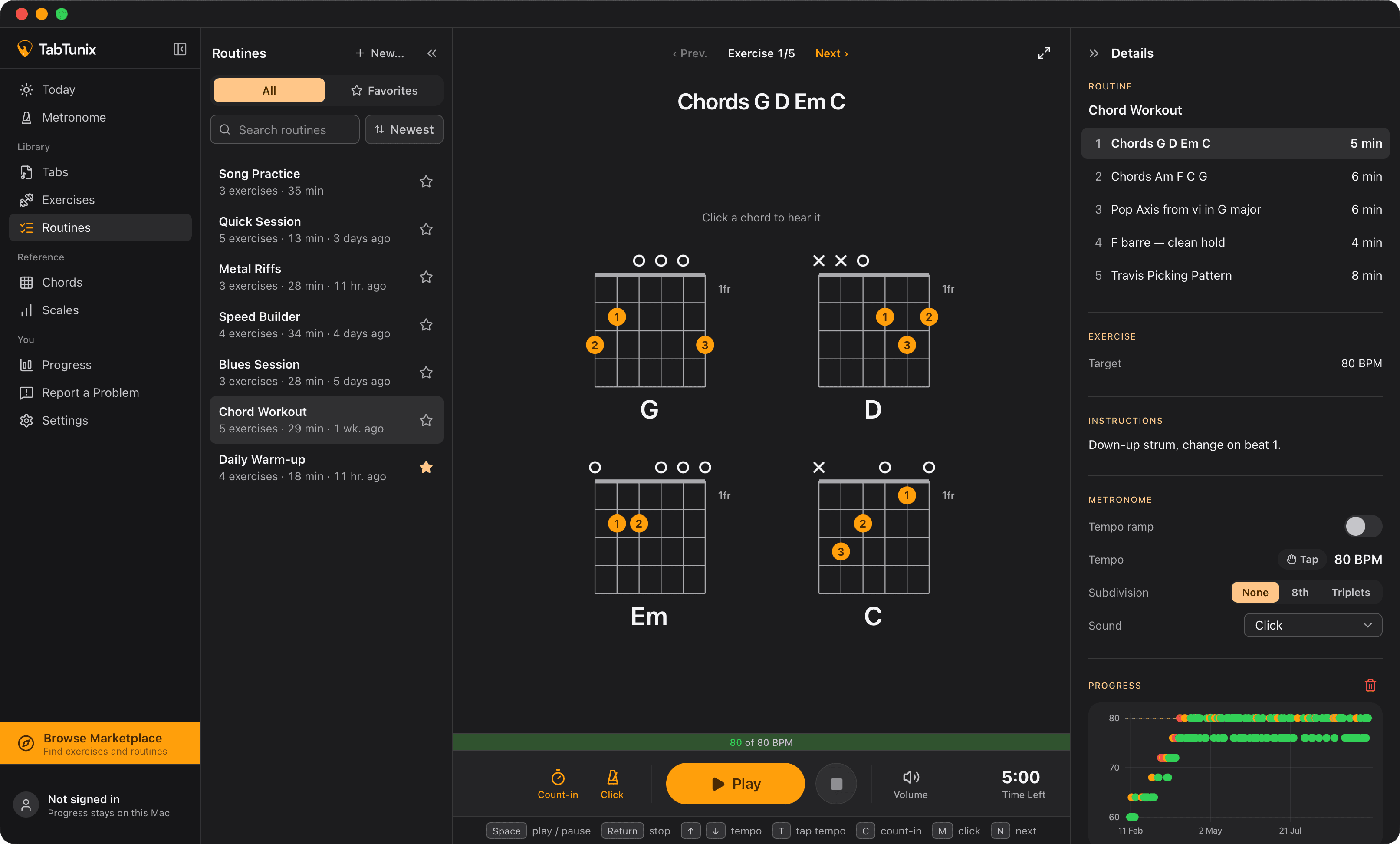
A routine running: the first of its five exercises, a chord change, and the routine's exercises with their minutes

In the app

Run your routine in a free guitar practice app

Put your exercises in TabTunix in the order you play them, give each its minutes, and the routine keeps time while you keep playing.

  • A countdown for every exercise that holds while you retune or rest your hand
  • No notebook: after each exercise you mark how it went at the tempo you played, and go straight on to the next
  • At the end, how long you played and how close each exercise came to its target tempo
  • An exercise can be the hard bars of a Guitar Pro tab, a chord change, a scale, or a plain click for anything else

Free exercise packs to start with

No exercises of your own yet? TabTunix's marketplace has free exercise packs to fill your routine with. Each exercise is a short tab with a target tempo, and you can hear it played before you choose. For the 15-minute routine, take your warm-up from First Steps and your two chords from Open Chords, then add a scale and the bars of a song you are learning.

  • Beginner

    First Steps

    Five warm-ups for clean, even playing

    For your warm-up

  • Beginner

    Open Chords

    Nine chord pairs for your first eight chords

    For your chord changes

  • Intermediate

    Building Blocks

    Five steps from clean notes to music

    For your technique

  • Intermediate

    Strumming

    Four progressions that don't sit still

    For your chord changes

  • Advanced

    Moving Up

    Five exercises where two things happen at once

    For your technique

Download for free

Start with the 15-minute routine, run it for a week, and see your tempos climb.

How to track your guitar practice

Time shows that you showed up; tempo shows that you improved. For each exercise, write down four things: the date, the exercise, the tempo you played it at, and how it went: clean, shaky or bad. The fastest tempo you marked clean is your best, and it is the number that counts: your minutes can rise while it stands still. A notebook will do, or print this page for the log with empty rows.

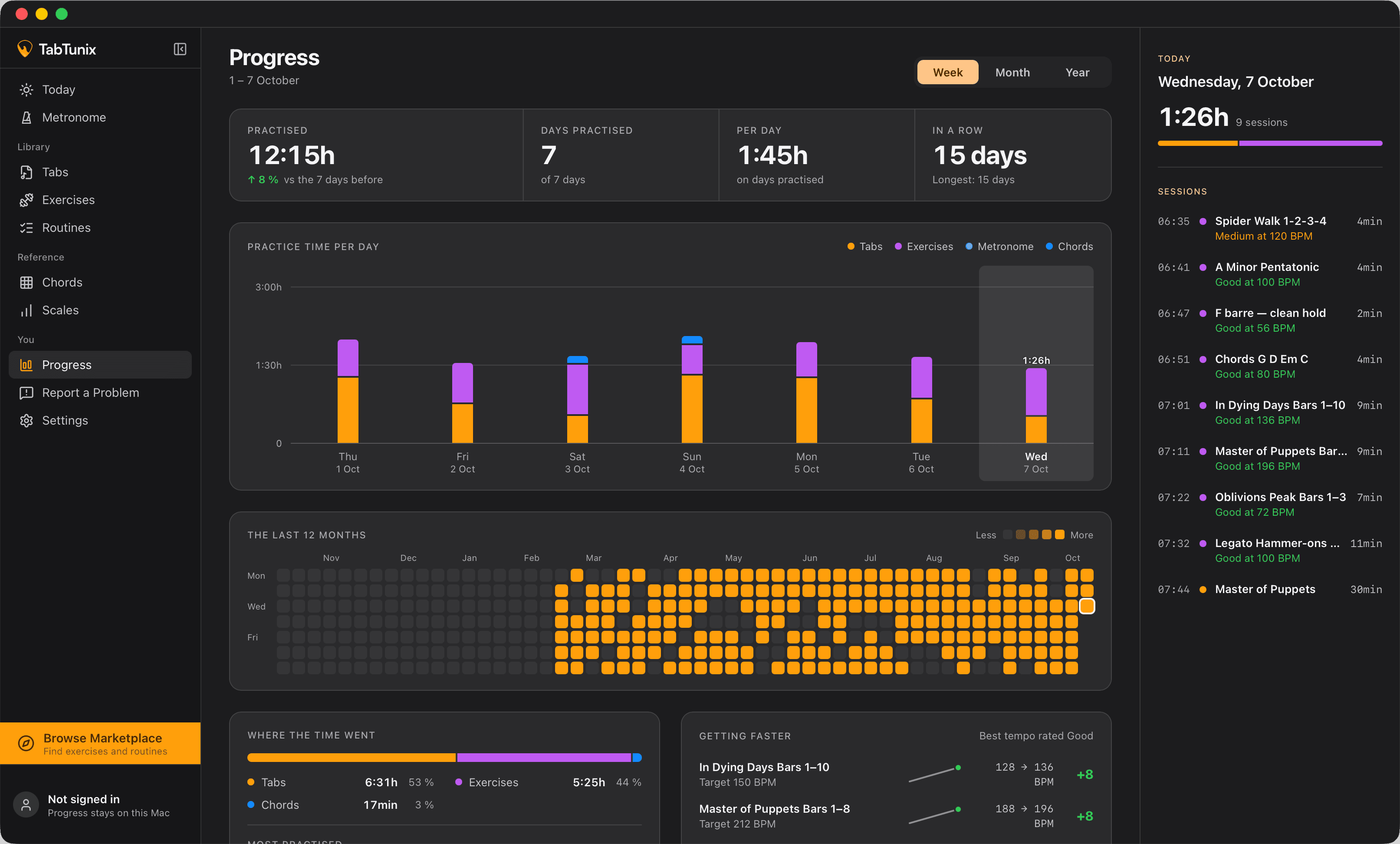
TabTunix keeps that log for you: every minute you play along to it, and your rating of each take at its tempo. By week, month or year you see how much you played, your days in a row, which exercises got faster, as from 96 to 104 BPM, and which reached their target. It keeps what you rate; it does not judge your playing.

The Progress screen: this week's practice time, the days in a row, the time per day and a calendar of the last twelve months
A practice log: the date, the exercise, the tempo and how it went
DateExerciseTempoHow it went
MonG to C changes72 BPMClean
TueG to C changes76 BPMShaky
WedG to C changes76 BPMClean

A guitar practice schedule for the week

Play the same routine all week rather than a new one each day: only then does the tempo you wrote down mean something. Practice five or six days and take one off. At the end of the week, change one block, the one you have outgrown, and keep the rest.

  1. Mon30 min
  2. Tue30 min
  3. Wed30 min
  4. Thu30 min
  5. Fri30 min
  6. Sat30 min
  7. SunDay off

How long should you practice guitar a day?

As a beginner, 15 to 30 minutes a day is enough to improve; once you know a few chords, 30 minutes on most days keeps you moving, and an hour is for moving up a level. Practicing often beats practicing long: five days of 20 minutes do more than one afternoon of two hours. Past an hour, split it in two with a break. And a planned 15 minutes does more than an hour of playing whatever comes to mind. If your hand or wrist hurts, stop.

Questions about guitar practice routines

Yes, for a few minutes, which is why every routine here starts with one: a slow finger exercise across all six strings, every note even, gets your hands moving before you ask them for speed. If anything hurts, stop.

Run your routine to the minute and see each exercise get faster. Free, for Mac and Windows.