Andalusian Cadence chord progression
The Andalusian cadence is a four-chord progression, i – bVII – bVI – V: Am, G, F and E in A minor. It steps down one chord a bar and lands on E, a major chord where the key has Em, and E pulls back to Am. In E minor the same numerals give Em, D, C and B.
Andalusian Cadence in A minor
Minori – bVII – bVI – V
Am G F E
Heard in “Hit the Road Jack” by Ray Charles
Standard tuning: E A D G B E
Key
Tuning
Chart
- Bar 1: Ami
- Bar 2: GbVII
- Bar 3: FbVI
- Bar 4: EV
Chords
The Andalusian Cadence bar by bar
The Andalusian cadence is four chords stepping down, one a bar: Am, G, F and E. The roots fall a whole step, a whole step, then a half step, and the last chord, a major one, leads back to the first.
Roman numerals name a chord by its place in the key, so i is Am in A minor and Em in E minor. Books also write it i – VII – VI – V, or vi – V – IV – III from the major key. For the chords of each key, see chords in a key.
The Andalusian Cadence in all 12 keys
The four chords step down the same way in every minor key, and the last always stays major: B in E minor.
| Key | Chords |
|---|---|
| C minor | Cm Bb Ab G |
| C# minor | C#m B A G# |
| D minor | Dm C Bb A |
| Eb minor | Ebm Db B Bb |
| E minor | Em D C B |
| F minor | Fm Eb Db C |
| F# minor | F#m E D C# |
| G minor | Gm F Eb D |
| G# minor | G#m F# E D# |
| A minorused here | Am G F E |
| Bb minor | Bbm Ab Gb F |
| B minor | Bm A G F# |
Variations on the Andalusian Cadence
Three progressions that also start on Am, each written out in A minor:
Minor Cadence, i – iv – V – i, in A minor
Am Dm E Am
Keeps the major E, but reaches it through Dm and comes home in the fourth bar.
Aeolian Vamp, i – bVII – bVI – bVII, in A minor
Am G F G
The same first three chords, then back to G in place of the major chord, so it never leaves the key.
Aeolian Descent, i – bVI – bIII – bVII, in A minor
Am F C G
Keeps to the key's own chords: F comes second, then C and G.
Step by step
How to practice the Andalusian Cadence
Get each change clean to a slow click, then play all four chords, then move them to another key.
- F to E: the same shape a fret lower, the barre gone.
- E back to Am: the same shape again, one string over.
- Am to G and G to F, the two changes before them.
- All four chords, one a bar, at a tempo where no change comes late.
- The same walk down in E minor, Em, D, C and B: this time the barre chord comes last, on B.
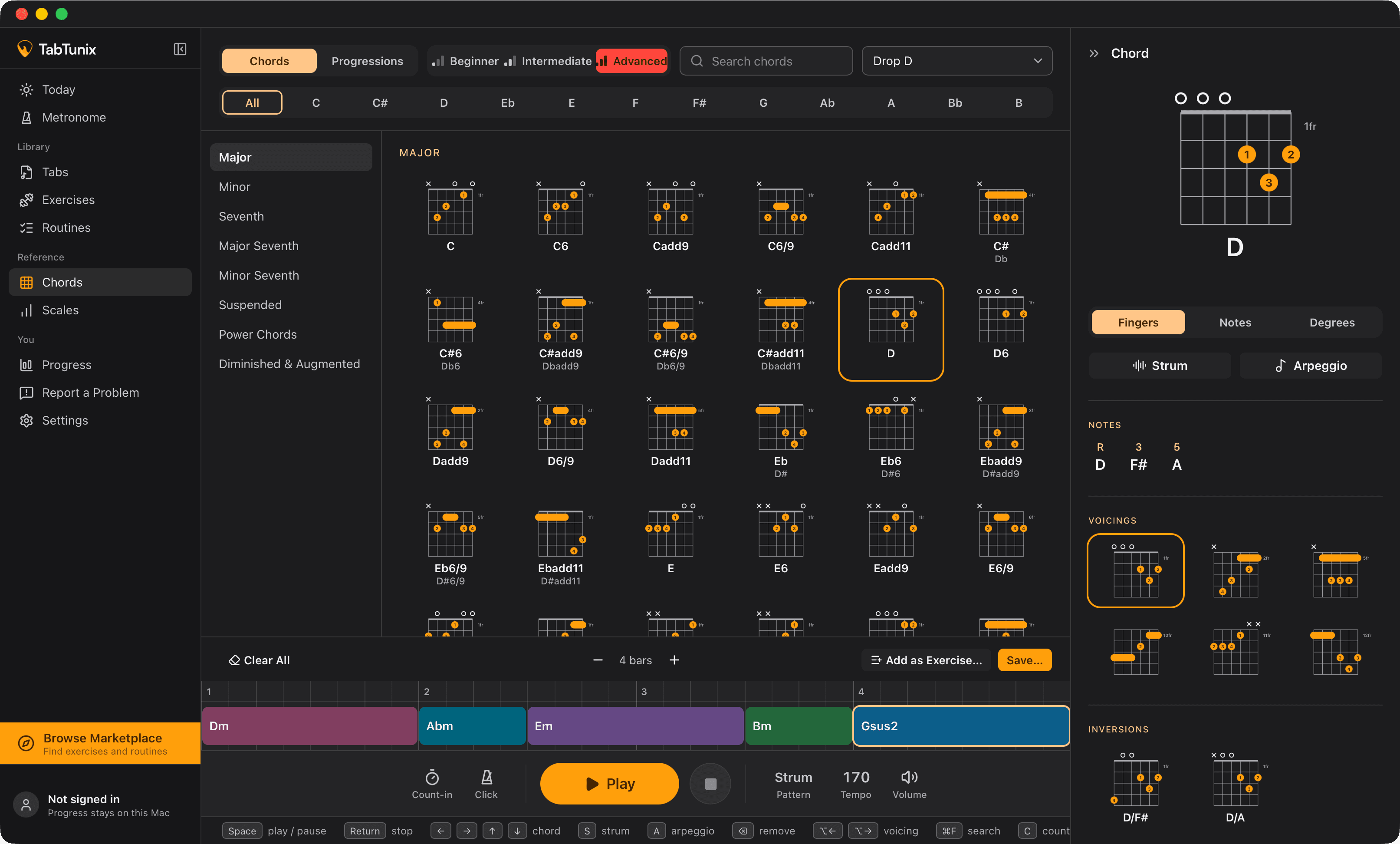
In TabTunix the four chords loop at your tempo with a click under them: one strum a bar while you learn the changes, a strum on every beat once they hold, or each chord picked note by note. Make it a chord-change exercise of Am, G, F and E with a tempo to reach.
Stuck on one change? Play just those two chords back and forth: that is how to change chords faster. A few minutes of it belong in any guitar practice routine.
Questions about the Andalusian Cadence
Play the four chords until the step from F to E takes no thought. Free, for Mac and Windows.