Chords in a key: a chart of all 24 keys
The chords in a key are the seven chords built on the notes of its scale: stack every other note on each note in turn. In C major that gives C, Dm, Em, F, G, Am and Bdim. Every major key follows I ii iii IV V vi vii°, every minor key i ii° bIII iv v bVI bVII.
| Key | I | ii | iii | IV | V | vi | vii° |
|---|---|---|---|---|---|---|---|
| C major | C | Dm | Em | F | G | Am | Bdim |
| Db majoralso written C# major | Db | Ebm | Fm | Gb | Ab | Bbm | Cdim |
| D major | D | Em | F#m | G | A | Bm | C#dim |
| Eb majoralso written D# major | Eb | Fm | Gm | Ab | Bb | Cm | Ddim |
| E major | E | F#m | G#m | A | B | C#m | D#dim |
| F major | F | Gm | Am | Bb | C | Dm | Edim |
| F# majoralso written Gb major | F# | G#m | A#m | B | C# | D#m | Fdim |
| G major | G | Am | Bm | C | D | Em | F#dim |
| Ab majoralso written G# major | Ab | Bbm | Cm | Db | Eb | Fm | Gdim |
| A major | A | Bm | C#m | D | E | F#m | G#dim |
| Bb majoralso written A# major | Bb | Cm | Dm | Eb | F | Gm | Adim |
| B major | B | C#m | D#m | E | F# | G#m | A#dim |
| Key | i | ii° | bIII | iv | v | bVI | bVII |
|---|---|---|---|---|---|---|---|
| C minor | Cm | Ddim | Eb | Fm | Gm | Ab | Bb |
| C# minoralso written Db minor | C#m | D#dim | E | F#m | G#m | A | B |
| D minor | Dm | Edim | F | Gm | Am | Bb | C |
| Eb minoralso written D# minor | Ebm | Fdim | Gb | Abm | Bbm | B | Db |
| E minor | Em | F#dim | G | Am | Bm | C | D |
| F minor | Fm | Gdim | Ab | Bbm | Cm | Db | Eb |
| F# minoralso written Gb minor | F#m | G#dim | A | Bm | C#m | D | E |
| G minor | Gm | Adim | Bb | Cm | Dm | Eb | F |
| G# minoralso written Ab minor | G#m | A#dim | B | C#m | D#m | E | F# |
| A minor | Am | Bdim | C | Dm | Em | F | G |
| Bb minoralso written A# minor | Bbm | Cdim | Db | Ebm | Fm | Gb | Ab |
| B minor | Bm | C#dim | D | Em | F#m | G | A |
A key with two names stands under the one that needs fewer sharps and flats, its other name beside it; where both need six, a major key takes the sharp and a minor key the flat: F# major, Eb minor. Each letter appears once in a key's scale, and where that would call for E# or Cb the chart writes the note that sounds: F# major's seventh chord is Fdim, not E#dim, and Eb minor's sixth chord is B, not Cb.
How to find the chords in a key
Take C major, the key without a sharp or a flat, and build its chords in four steps:
- Write out its scale: C D E F G A B.
- From each note take every other note, three times, which is called stacking thirds: C E G, D F A, E G B and so on up the scale.
- Name each chord by its notes: C E G is C, D F A is Dm, B D F is Bdim.
- Stack one more note the same way for the seventh chords: C E G B is Cmaj7, G B D F is G7.
Every major key gives the same pattern: major, minor, minor, major, major, minor and diminished. A minor key, built on its own scale, gives minor, diminished, major, minor, minor, major and major. Chords taken from a key's scale this way are its diatonic chords. Each key's scale on the neck is under guitar scales.
Roman numerals and Nashville numbers
A Roman numeral names a chord by its place in the key: I is the chord on the first note, IV the chord on the fourth. Upper case is a major chord, lower case a minor one, and ° a diminished one. A b marks a place a half step lower than in the major scale, which is why a minor key reads i, ii°, bIII, iv, v, bVI, bVII. Some books count a minor key from its own scale and leave the b out, i, ii°, III, iv, v, VI, VII: the chords are the same.
Written in numerals, a progression holds in every key: IV is F in C major and C in G major. TabTunix writes its chord progressions in Roman numerals. Nashville numbers count the same places in digits, 1 to 7, so I – IV – V is 1 – 4 – 5.
| Place | Roman numeral | Nashville number | In C major | In G major |
|---|---|---|---|---|
| 1st | I | 1 | C | G |
| 2nd | ii | 2 | Dm | Am |
| 3rd | iii | 3 | Em | Bm |
| 4th | IV | 4 | F | C |
| 5th | V | 5 | G | D |
| 6th | vi | 6 | Am | Em |
| 7th | vii° | 7 | Bdim | F#dim |
Chords that go together
Chords that go together are, first of all, the chords of one key: in G major, G, Am, Bm, C, D, Em and F#dim. Its three major chords, G, C and D on the first, fourth and fifth notes, make the I – IV – V; with Em they make the Pop Axis, G – D – Em – C.
Holding one chord? Each key it belongs to gives it other companions. G belongs to six, in the table here, and each chord page under guitar chords lists its own keys.
Relative major and minor keys
Every major key has a minor key with the same seven notes and the same seven chords, starting on its sixth note: C major and A minor share theirs, and A minor's chords are C major's, counted from Am. The minor key is the major key's relative minor, and the major key its relative major.
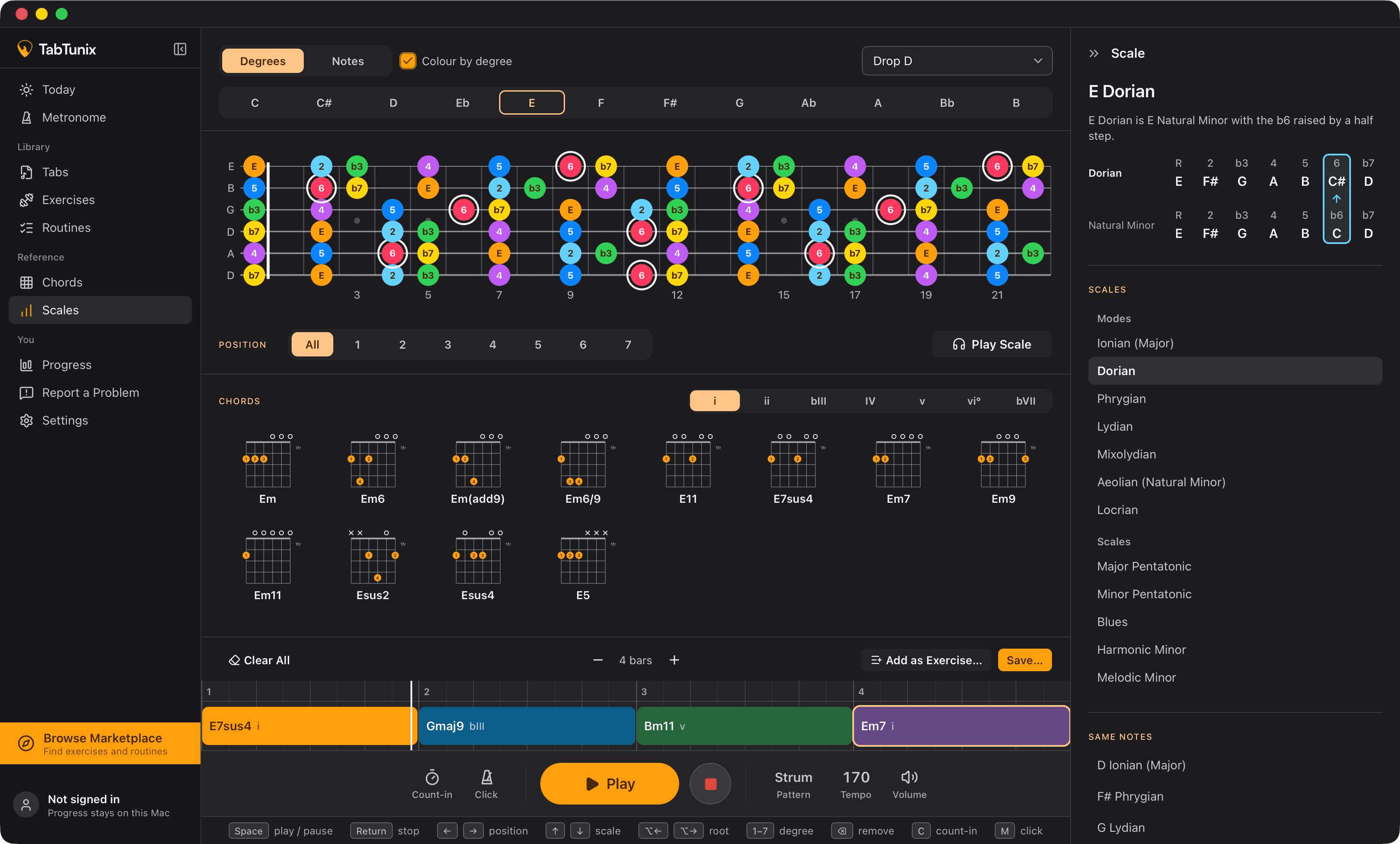
In the app
Play the chords of a key
Pick any of the 24 keys in TabTunix, loop its chords in any order and play over them at your tempo. Keep a loop as a progression of your own, or as an exercise to come back to.
The progressions guitarists play in every key are under chord progressions.