Guitar modes explained: what each mode changes
By TabTunix · Published
Guitar modes are the seven scales you get by playing the major scale from each of its notes: Ionian, Dorian, Phrygian, Lydian, Mixolydian, Aeolian and Locrian. Play G major's notes from A to A and you have A Dorian. The notes stay; what changes is which note is home, and one chord against that home tells you the mode.
Position
- 1: frets 5 to 9, 17 to 21
- 2: frets 7 to 10, 19 to 22
- 3: frets 8 to 12
- 4: frets 10 to 14
- 5: frets 0 to 4, 12 to 16
- 6: frets 2 to 5, 14 to 17
- 7: frets 3 to 7, 15 to 19
A Dorian
A Dorian is A Natural Minor with the b6 raised by a half step.
Dorian: degrees R 2 b3 4 5 6 b7, notes A B C D E F# G. Natural Minor: degrees R 2 b3 4 5 b6 b7, notes A B C D E F G.
Modes
Scales
Same notes
Chords
What are the modes of the major scale?
A mode is the major scale started on another of its notes: one set of seven notes with seven homes. The first mode is the major scale itself and the sixth is the natural minor, so you already know two of them.
G major is the parent scale of these seven: every row holds the same notes, and all seven share the chords of G major. What moves is the home note, the note the music rests on.
| Mode | Starts on | Notes |
|---|---|---|
| Ionian (Major) | G | G A B C D E F# |
| Dorian | A | A B C D E F# G |
| Phrygian | B | B C D E F# G A |
| Lydian | C | C D E F# G A B |
| Mixolydian | D | D E F# G A B C |
| Aeolian (Natural Minor) | E | E F# G A B C D |
| Locrian | F# | F# G A B C D E |
Guitar modes chart: the seven modes in order
The seven modes of the major scale in order, on A. Each name leads to the mode's positions and every key. Print this page for the chart on one sheet, or save it as a PDF.
| Mode | Formula | What it changes | Giveaway chord on A | Used for |
|---|---|---|---|---|
| Ionian (Major) | R 2 3 4 5 6 7 | The major scale | — | Pop, rock and folk melodies |
| Dorian | R 2 b3 4 5 6 b7 | Natural minor with a 6 | D (IV) | Minor grooves in funk, rock and jazz |
| Phrygian | R b2 b3 4 5 b6 b7 | Natural minor with a b2 | Bb (bII) | Riffs in metal and flamenco |
| Lydian | R 2 3 #4 5 6 7 | Major with a #4 | B (II) | Melodies in film music |
| Mixolydian | R 2 3 4 5 6 b7 | Major with a b7 | G (bVII) | Rock and blues riffs over major chords |
| Aeolian (Natural Minor) | R 2 b3 4 5 b6 b7 | The natural minor scale | — | Minor-key songs in rock, pop and metal |
| Locrian | R b2 b3 4 b5 b6 b7 | Natural minor with a b2 and b5 | Adim (i°) | Metal riffs |
What each mode changes in the major or minor scale
Put every mode on one root and you see what it changes. Ionian is the major scale and Aeolian the natural minor; the other five are one of those two with one or two notes changed: the major scale for a mode with a major third, the natural minor for a mode with a minor third.
A Dorian changes one note of A Natural Minor: F, its b6, goes up a half step to F#. On these two necks the ringed F# sits a fret above the F, and every other note stays where it is.
The chart of the seven modes names that change for every mode, and each mode's own page, as Dorian's, shows its difference in full. For the pentatonics and blues, see guitar scales.
A Dorian, position 1: its F# ringed
A Natural Minor, position 1: F in its place
How modes work on the neck: same notes, different home
A mode is which note is home, not a place on the neck. Put the seven modes of a family on the fretboard and they are the same dots; only the home note moves. So a box is not a mode: A Dorian's position 1 is G Ionian (Major)'s position 2, the same frets under another number.
What sets that home is the chords under you: over Am and D these dots are A Dorian, over G and C they are G major. You find the home note anywhere on the neck once you know every note on the fretboard.
How to use modes when you play
To use a mode, play it over its home chord and the chord that gives it away. A mode has several chords the major or natural minor scale lacks, and the major one among them is the giveaway: in A Dorian that is D on the fourth degree, where A Natural Minor has Dm. That D holds the F#, the note that makes it Dorian. So to use a mode:
- Take its chords. A mode has the chords of its family: A Dorian has those of G major, and you find them under chords in a key.
- Find the chord that gives it away. The chart names it for every mode. In Locrian it is the home chord itself, so pair Adim with Bb.
- Play the two in turn, the home chord and that one: Am and D for A Dorian, the Dorian Vamp. Play the mode over them and come to rest on its root.
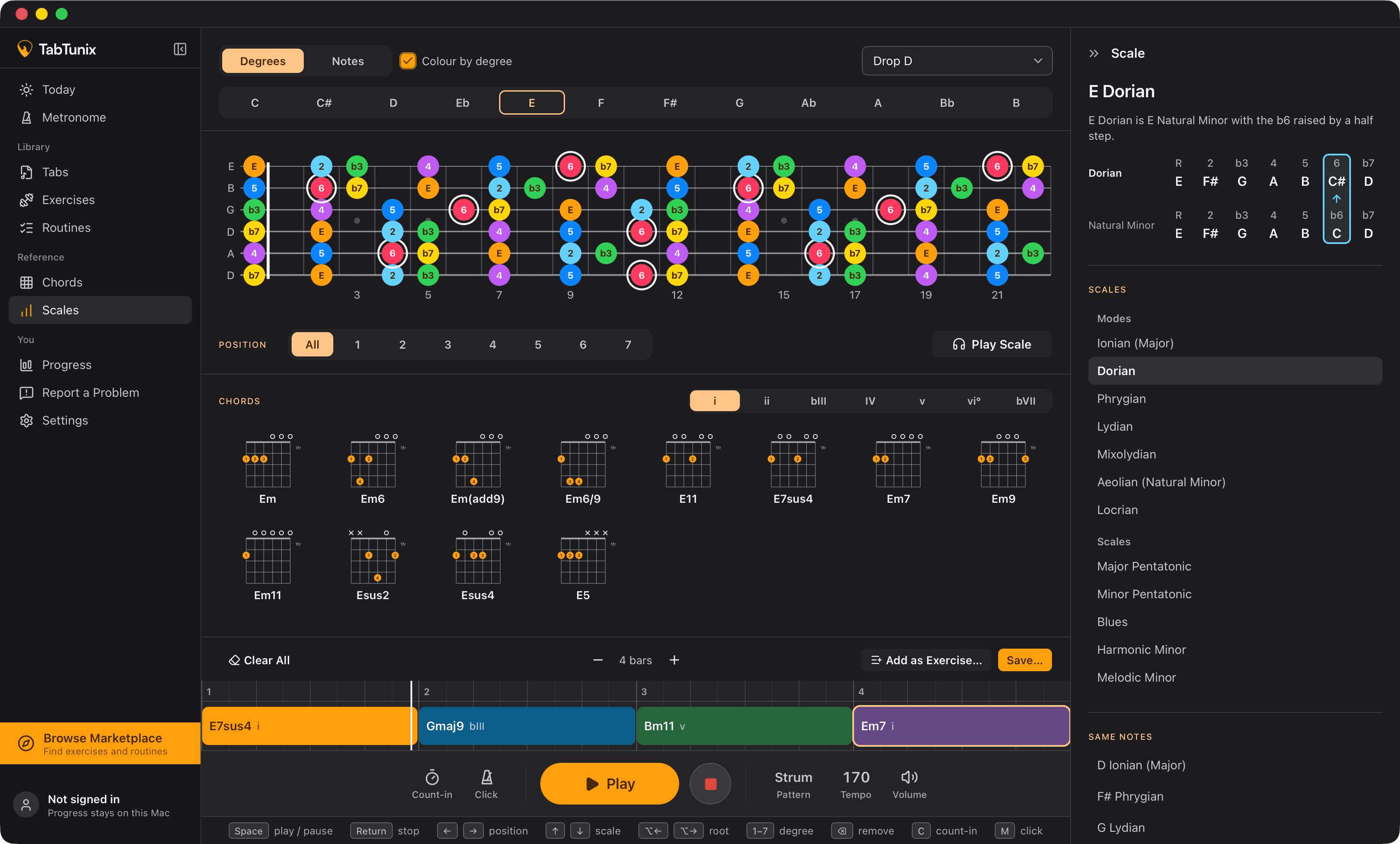
In the app
How to practice modes on guitar
Take one mode at a time and hear it before you play it. Then loop its two chords, play slowly over them and land on the note that sets the mode apart. TabTunix has Dorian, Phrygian, Lydian and Mixolydian vamps ready to loop in any key at your tempo, and turns any mode into an exercise with a target tempo.
You learn a mode's positions like any scale's: how to practice scales holds for modes too.
Questions about guitar modes
Two chords on a loop and you are playing a mode. Free, for Mac and Windows.