Guitar tuning chart: notes, octaves and uses
A guitar tuning chart gives the note each string is tuned to. Standard is E A D G B E from the lowest string; Drop D, Drop C, Drop B and DADGAD lower some of those strings or all of them, each shown here with its octave. It is a chart to look up, not a tuner.
| Tuning | Strings, lowest first | From Standard, half steps | Often used for | |
|---|---|---|---|---|
| Standard | E2 A2 D3 G3 B3 E4 | 0 0 0 0 0 0 | almost everything; most charts and lessons assume it | Standard tuning notes |
| Drop D | D2 A2 D3 G3 B3 E4 | −2 0 0 0 0 0 | heavier rock and folk | Drop D chords, scales and notes |
| Drop C | C2 G2 C3 F3 A3 D4 | −4 −2 −2 −2 −2 −2 | metal and heavy rock | Drop C chords, scales and notes |
| Drop B | B1 F#2 B2 E3 G#3 C#4 | −5 −3 −3 −3 −3 −3 | very low metal | |
| DADGAD | D2 A2 D3 G3 A3 D4 | −2 0 0 0 −2 −2 | Celtic music and fingerstyle | DADGAD chords, scales and notes |
A chart, not a tuner
This page does not hear your guitar and sounds no note, so tune your strings to the chart's notes with a tuner. The TabTunix app has one: it names the note a string plays and lists these tunings, and others, to tune to. Once your strings are tuned, the pages for Drop D, Drop C and DADGAD show you what to play.
What changes from standard tuning
Drop D lowers the lowest string a whole step and nothing else. Drop C and Drop B are Drop D tuned down, a whole step and three half steps, so every string is lower than in Standard. DADGAD lowers three strings, the lowest, the B string and the highest, each a whole step.
A chord is named by what sounds, so a chart for Standard does not carry over fret for fret: G's barre 3 5 5 4 3 3 is 5 5 5 4 3 3 in Drop D.
Standard tuning notes
The notes of the guitar strings in standard tuning are E A D G B E, from the thickest string, the 6th, to the thinnest, the 1st: E2 A2 D3 G3 B3 E4 with their octaves. Each fret is a half step, so every note on the fretboard follows from these six. It is the tuning guitar chords are written for unless a chart says otherwise.
Other alternate tunings
Open G is D G D G B D, Open D is D A D F# A D, Half Step Down is Eb Ab Db Gb Bb Eb, Whole Step Down is D G C F A D and Drop C# is C# G# C# F# A# D#. TabTunix's tuner lists more to tune to, and a scale exercise in the app can also be set in the two step-down tunings, but its chords and scales are drawn in the five of the chart.
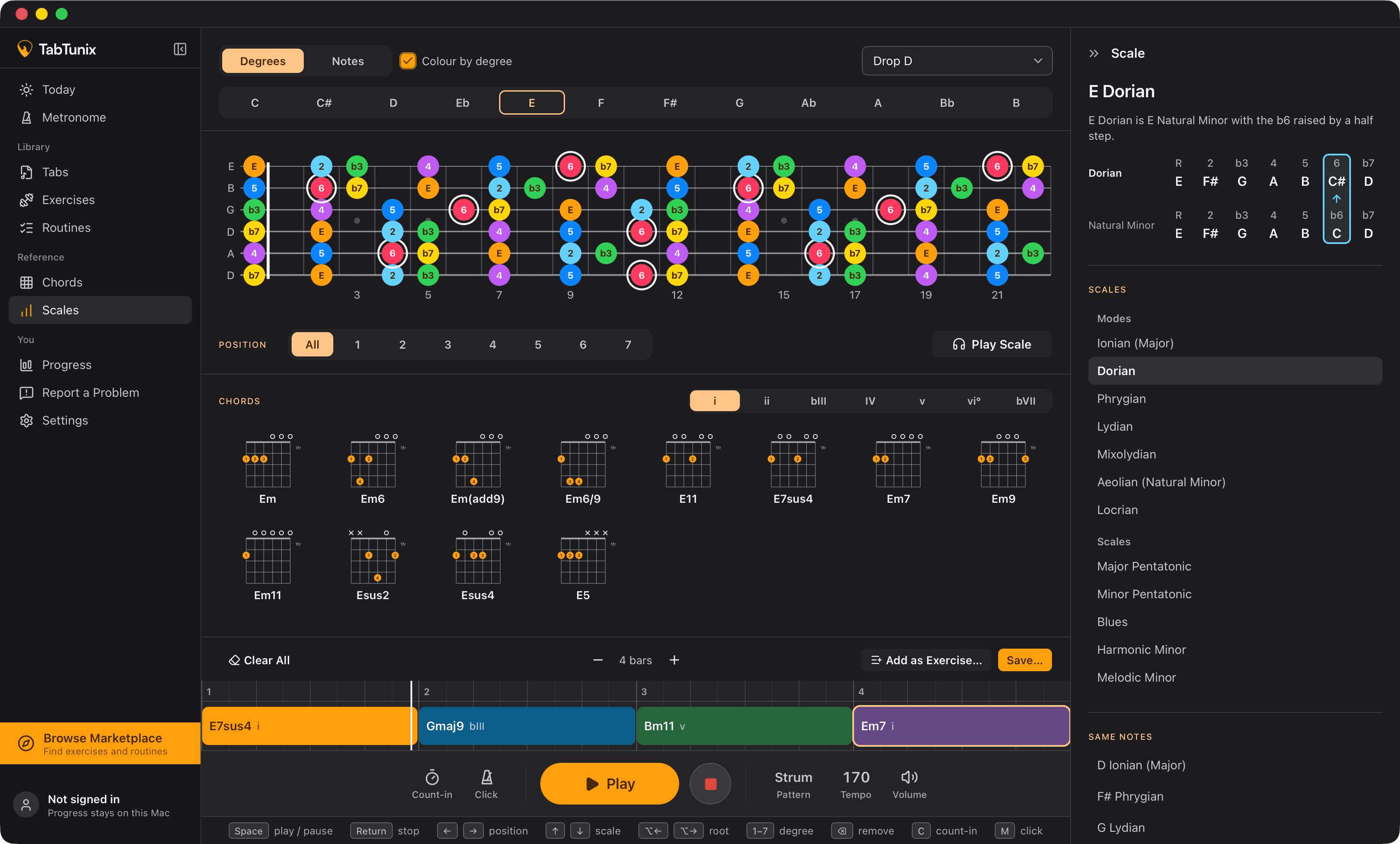
In the app
Play in all five tunings
Practice in the tuning you play in: what you look up in TabTunix is drawn and sounds in it, and a scale you keep as an exercise, with a target tempo, waits in its tuning for next time.
More on getting a scale under your fingers in how to practice scales.