12-Bar Blues chord progression
The 12-bar blues is a chord progression of three seventh chords, I7, IV7 and V7: A7, D7 and E7 in A major. It stays on A7 for four bars, moves to D7 and back, then runs E7, D7, A7 and E7 into the next round. In E major the same numerals give E7, A7 and B7.
12-Bar Blues in A major
MajorI7 – IV7 – V7
A7 D7 E7
Heard in “Johnny B. Goode” by Chuck Berry
Standard tuning: E A D G B E
Key
Tuning
Chart
- Bar 1: A7I7
- Bar 2: A7I7
- Bar 3: A7I7
- Bar 4: A7I7
- Bar 5: D7IV7
- Bar 6: D7IV7
- Bar 7: A7I7
- Bar 8: A7I7
- Bar 9: E7V7
- Bar 10: D7IV7
- Bar 11: A7I7
- Bar 12: E7V7
Chords
The 12-Bar Blues bar by bar
The 12-bar blues runs three lines of four bars, four beats a bar. In A major the first line is four bars of A7, the second two of D7 and two of A7, the third E7, D7, A7 and E7, one bar each. The last two bars are the turnaround, and the last bar leads back to the first.
Roman numerals name a chord by its place in the key, so I7 is A7 in A major and E7 in E major. For the chords of each key, see chords in a key.
The 12-Bar Blues in all 12 keys
The form is the same in every key, only the chords move. Each row names I7, IV7 and V7 in turn; the chart above gives their order bar by bar.
| Key | Chords |
|---|---|
| C major | C7 F7 G7 |
| Db major | Db7 Gb7 Ab7 |
| D major | D7 G7 A7 |
| Eb major | Eb7 Ab7 Bb7 |
| E major | E7 A7 B7 |
| F major | F7 Bb7 C7 |
| F# major | F#7 B7 C#7 |
| G major | G7 C7 D7 |
| Ab major | Ab7 Db7 Eb7 |
| A majorused here | A7 D7 E7 |
| Bb major | Bb7 Eb7 F7 |
| B major | B7 E7 F#7 |
Variations on the 12-Bar Blues
Three close relatives of the 12-bar blues, each written out in A:
Quick-Change Blues, I7 – IV7 – V7, in A major
A7 D7 A7 A7 / D7 D7 A7 A7 / E7 D7 A7 E7
Bar 2 goes to D7 and straight back, the move players call the quick four; the rest is the 12-bar form.
8-Bar Blues, I7 – V7 – IV7, in A major
A7 E7 D7 D7 / A7 E7 A7 E7
Eight bars in place of twelve, with E7 already in bar 2.
Minor Blues, i7 – iv7 – bVI7 – V7, in A minor
Am7 Am7 Am7 Am7 / Dm7 Dm7 Am7 Am7 / F7 E7 Am7 E7
Twelve bars in a minor key, with F7 a half step above the E7 it falls to in bars 9 and 10.
Step by step
How to practice the 12-Bar Blues
Get each change clean to a slow click, then play the whole form, then move it to another key.
- A7 to D7 in bar 5, and back in bars 7 and 11: the first change of the form.
- The last four bars, E7, D7, A7 and E7: a new chord on every bar.
- All twelve bars at a tempo where no change comes late, counting the bars as you go.
- The same form in E major, E7, A7 and B7: you know E7 and A7 already, and B7 is the one new shape.
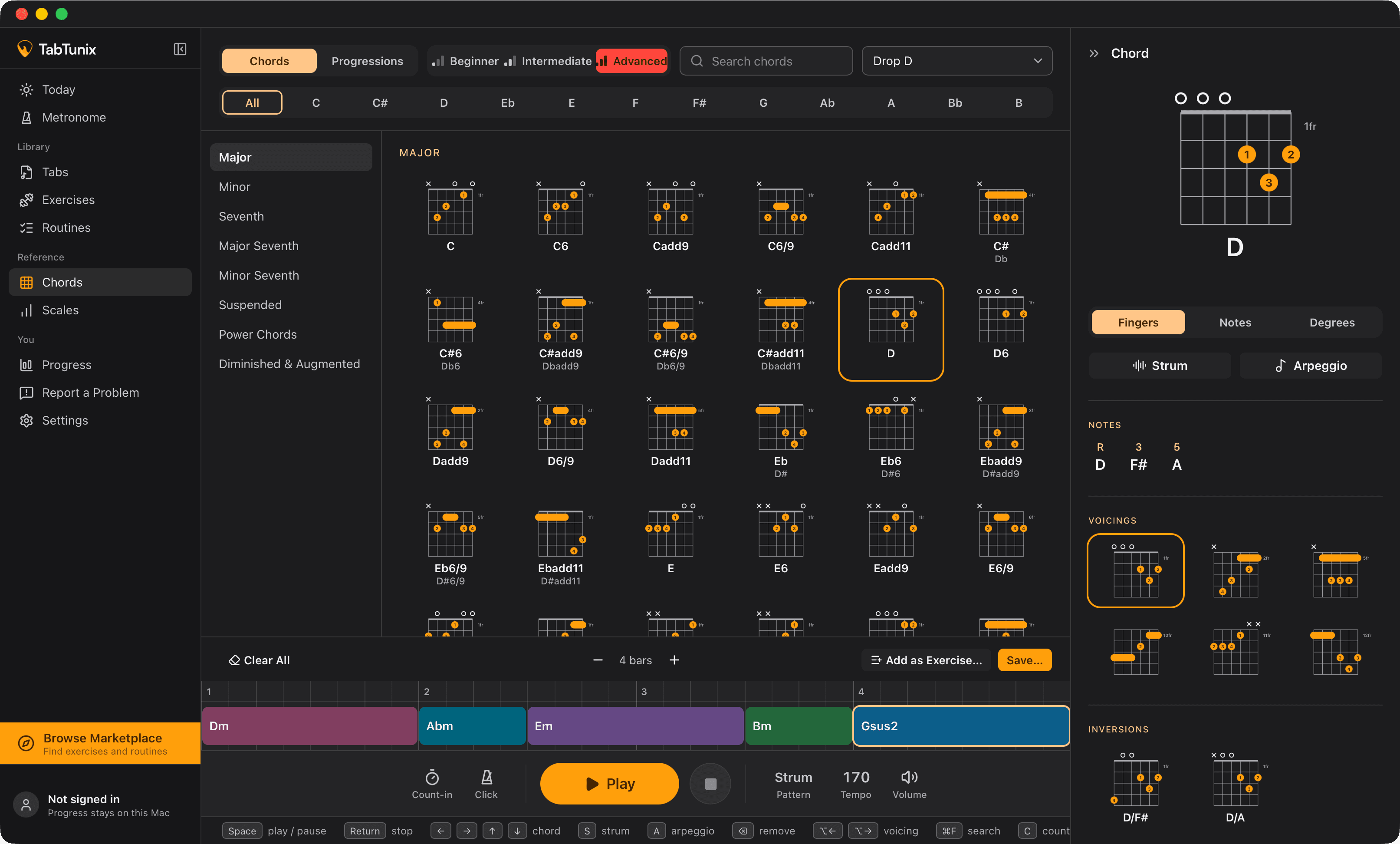
In TabTunix the twelve bars loop at your tempo with a click under them: one strum a bar while you learn the changes, a strum on every beat once they hold, or each chord picked note by note. Make it a chord-change exercise of A7, D7 and E7 with a tempo to reach.
Stuck on one change? Play just those two chords back and forth: that is how to change chords faster. A few minutes of it belong in any guitar practice routine.
Questions about the 12-Bar Blues
Play the twelve bars until you stop counting them. Free, for Mac and Windows.