Guitar exercises: 4 tabs with a tempo to reach
By TabTunix · Published
Four guitar exercises train both hands, each written as tab with a tempo to reach, 80 to 100 BPM: the spider for your fingers, alternate picking, a legato run and string skipping. Start each at the tempo where every note is clean, raise it a few BPM after a clean run, and stop if anything hurts.
How to use these exercises
Play each one to a metronome, with one or two notes to each click as the exercise says. Its tempo to reach is a suggestion, not a standard: stay below it until the tempo you are at feels easy. Printed, this page gives all four on one sheet, each with its tempo and its tab.
The online metronome clicks in your browser, and practice with a metronome shows how to climb to a target step by step.
| Mark | Means |
|---|---|
| e B G D A E | The six strings, the thinnest at the top |
| 5 | A fret: press the string there |
| h | Hammer-on: sound the next note with the fretting finger alone |
| p | Pull-off: pull the finger off to sound the lower note |
| D U | Under a line: pick down, pick up |
The spider: a finger exercise (1-2-3-4)
The spider, or spider walk, is a chromatic finger exercise: one finger to each fret, index on fret 5, middle on 6, ring on 7, little finger on 8, picking down and up in turn. Play 1-2-3-4 on every string from the low E up, then the same backward from the high e down. It trains finger independence: each finger lands on its own, without the others moving, which is why it makes a good warm-up.
Tempo to reach: 100 BPM, one note to each click.
e|-----------------------------------------5-6-7-8-|
B|---------------------------------5-6-7-8---------|
G|-------------------------5-6-7-8-----------------|
D|-----------------5-6-7-8-------------------------|
A|---------5-6-7-8---------------------------------|
E|-5-6-7-8-----------------------------------------|
e|-8-7-6-5-----------------------------------------|
B|---------8-7-6-5---------------------------------|
G|-----------------8-7-6-5-------------------------|
D|-------------------------8-7-6-5-----------------|
A|---------------------------------8-7-6-5---------|
E|-----------------------------------------8-7-6-5-|
Play A, then B, and go round again: the 8 on the high e ends A and starts B, so it sounds twice.
Alternate picking exercise: down, up, down, up
Strict alternate picking: a downstroke on the click and an upstroke between, whatever the notes do, with one finger to each fret as in the spider. Part A stays on one string; part B crosses four, where the picking hand most often falls out of its pattern.
Tempo to reach: 90 BPM, two notes to each click.
e|---------------------------------|
B|-5-6-7-8-8-7-6-5-5-6-7-8-8-7-6-5-|
G|---------------------------------|
D|---------------------------------|
A|---------------------------------|
E|---------------------------------|
 |-D U D U D U D U D U D U D U D U
e|-------------5-6-6-5-------------|
B|---------5-6---------6-5---------|
G|-----5-6-----------------6-5-----|
D|-5-6-------------------------6-5-|
A|---------------------------------|
E|---------------------------------|
 |-D U D U D U D U D U D U D U D U
Keep the pick moving down and up even where the string changes.
Legato exercise: hammer-ons and pull-offs
Pick only the first note of each group; the rest sound from the fretting hand alone, hammered on going up and pulled off coming down. Fingers 1-2-3-4 on frets 5-6-7-8, on four strings.
Tempo to reach: 80 BPM, one note to each click.
e|-------------------------------------------5h6h7h8p7p6p5-|
B|-----------------------------5h6h7h8p7p6p5---------------|
G|---------------5h6h7h8p7p6p5-----------------------------|
D|-5h6h7h8p7p6p5-------------------------------------------|
A|---------------------------------------------------------|
E|---------------------------------------------------------|
Aim for an even volume: a hammered or pulled note should not be quieter than the picked one.
String skipping exercise
The pick jumps over a string: notes on the D and B strings with the G string skipped, frets 5 to 8 and back with one finger to each fret, in alternate picking. It is the move of many riffs and arpeggios.
Tempo to reach: 90 BPM, two notes to each click.
e|---------------------------------|
B|---5---6---7---8---8---7---6---5-|
G|---------------------------------|
D|-5---6---7---8---8---7---6---5---|
A|---------------------------------|
E|---------------------------------|
 |-D U D U D U D U D U D U D U D U
Keep the pick close to the strings, so the jump costs no time.
How to change chords faster
Chord changes get faster the way a run does: two chords at a time, to a click, at a tempo that rises once every change is clean.
- Take two chords of a song, such as G and C, or Em and Am, and hold each slowly until you know the shape.
- Move all your fingers at once, and leave down any finger that keeps its fret in both chords.
- Set a click at a tempo where you can change on every beat and land the chord clean. For most people that is slow.
- Change on the click, not when you are ready.
- Raise the tempo a few BPM after a clean round, and go back a step when it falls apart. Play rounds of about a minute, with a rest for the hand between.
A change on every click at 60 BPM is 60 changes a minute. When a pair is easy, join four chords into a loop, one to a bar, as the chord progressions do, and take the chords from the guitar chords you know or from the chords in a key of your song.
In the app
Run them at a tempo in a free guitar practice app
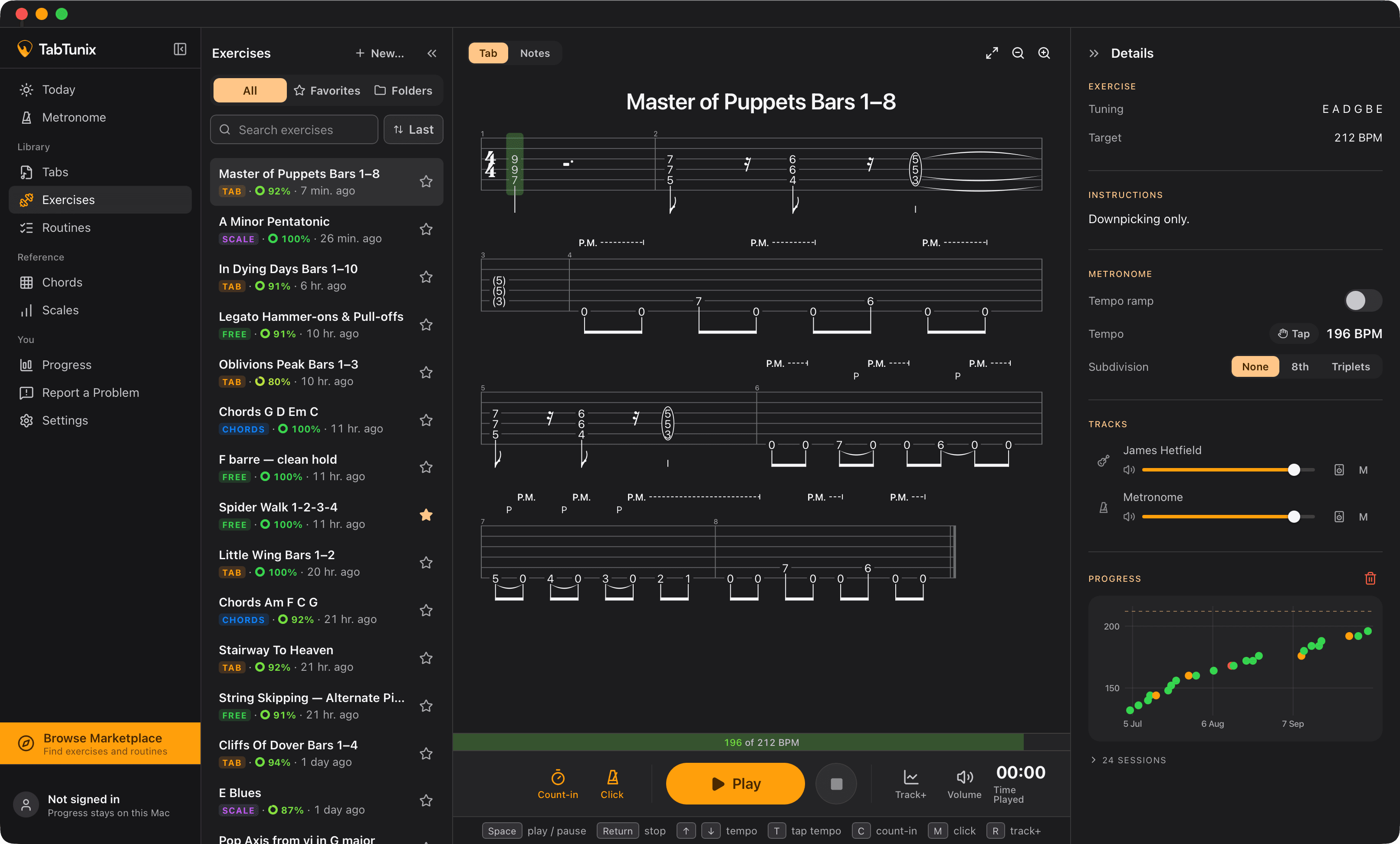
In TabTunix each of the four becomes an exercise of your own, kept with its tempo to reach and your notes on how to play it.
- A click at your tempo, or a drum groove in its place, that can rise a few BPM every few bars until it reaches the target
- For a chord pair, both shapes to see and hear, and rounds of a minute with a countdown
- After each take, your rating at the tempo you played, and a chart of your takes with the target as a line
To start without writing your own, TabTunix's marketplace has free exercise packs, each exercise a short tab with a target tempo that you can hear at that tempo first: Open Chords, whose nine pairs include G and C and Em and Am, for your chord changes, and First Steps and Building Blocks for your fretting and picking hands.
Run the spider at a click, set 100 BPM as your target, and watch your tempo climb.
Download for freeGuitar exercises to do every day
Start each day with five minutes of the spider, then five of one of the other three and five of your chord pair. A guitar practice routine gives each exercise its own minutes and adds a scale and a song; scales have a method of their own in how to practice guitar scales.
Questions about guitar exercises
Put all four in one routine and see which one reaches its tempo first. Free, for Mac and Windows.