How to practice guitar scales, one box at a time
By TabTunix · Published
To practice guitar scales, take one scale in one position and play it slowly to a click. Once the whole box is clean, raise the tempo a few BPM at a time. When it is easy, learn the next box and join the two, until you play the scale across the neck. Note your best clean tempo each day.
How to practice a scale: six steps
- One scale, one key, one box. Start with the minor pentatonic in A, position 1: frets 5 to 8, two notes on each string, the scale of most rock and blues solos.
- Find the root. Every A is marked on the box: the low E string at fret 5, the D string at fret 7 and the high E string at fret 5. Play the three, low to high, until you find each without looking; the fretboard notes show where every other note sits.
- Play the box up and down with no click. From the lowest note to the highest and back, picking down and up in turn, until every note rings clean and none is skipped.
- Add a click at a tempo where the whole box is clean. The tempo where you play it up and down three times in a row without a miss, however slow. Write it down.
- Raise the tempo a few BPM after a clean run. When it falls apart, go back to the last clean tempo and play it there before you try again.
- When the box is easy, take the next one. Then play the boxes in a row across the neck, then the same in another key. The next scale to learn is the major scale.
Ten minutes on one box do more than two minutes on each of five. Stop if it hurts.
Practice guitar scales with a metronome
Play one note to each click first: the click shows at once a note that comes early or late. When one note a click is easy, play two notes to each click at the same tempo, and start every run on the root, on the first beat of the bar, so you hear where the scale begins.
Your target is a tempo above the one you wrote down: the tempo of a solo or a riff you want to play. How to get from one to the other in small steps is in how to use a metronome. When you play two or three notes to each click, eighths and triplets mark where every note goes.
Guitar scale exercises in one box
Once the box is clean up and down, play it in patterns, so you know every note of it and not only the run. Take each up the box and back down, slower at first than the plain run.
- Groups of three: A C D, C D E, D E G, and on up the box; three notes to each click.
- Groups of four: A C D E, C D E G, D E G A, and on up the box; two notes to each click.
- Skipping a note: A D, C E, D G, E A, and on up the box; one note to each click.
- Start anywhere: begin the run on a C or an E of the box, and end on the note you began on.
From one box to the whole neck
The five boxes of a pentatonic overlap: on every string, the higher note of one box is the lower note of the next. In A, box 1 runs from fret 5 to 8 and box 2 from 7 to 10, so the C at fret 8 on the low E string belongs to both.
Learn each box alone, as in the steps above. Then find the notes it shares with the next one, and play the two in a row, up through the first and on into the second. When two run together, add a third, until all five cross the neck. All five boxes of the minor pentatonic are drawn on its page.
A scale of seven notes, the major scale or one of the modes, has seven boxes, each played in position within five frets: the same plan, with seven shapes. Every scale's boxes are on its own page under guitar scales.
A ten-minute scale practice session
A plan to start from, not a rule: two minutes without the click, eight with it, and at the end the fastest tempo where the box stayed clean, written down. In a longer practice it is one block of your guitar practice routine, beside guitar exercises for your hands.
| Minutes | What to play |
|---|---|
| 2 min | The root and the box, up and down, no click |
| 3 min | One note to a click, at the tempo where the box is clean |
| 3 min | A few BPM up, a step at a time |
| 2 min | Two notes to a click, back at the tempo you started at |
In the app
Make a scale an exercise with a target tempo
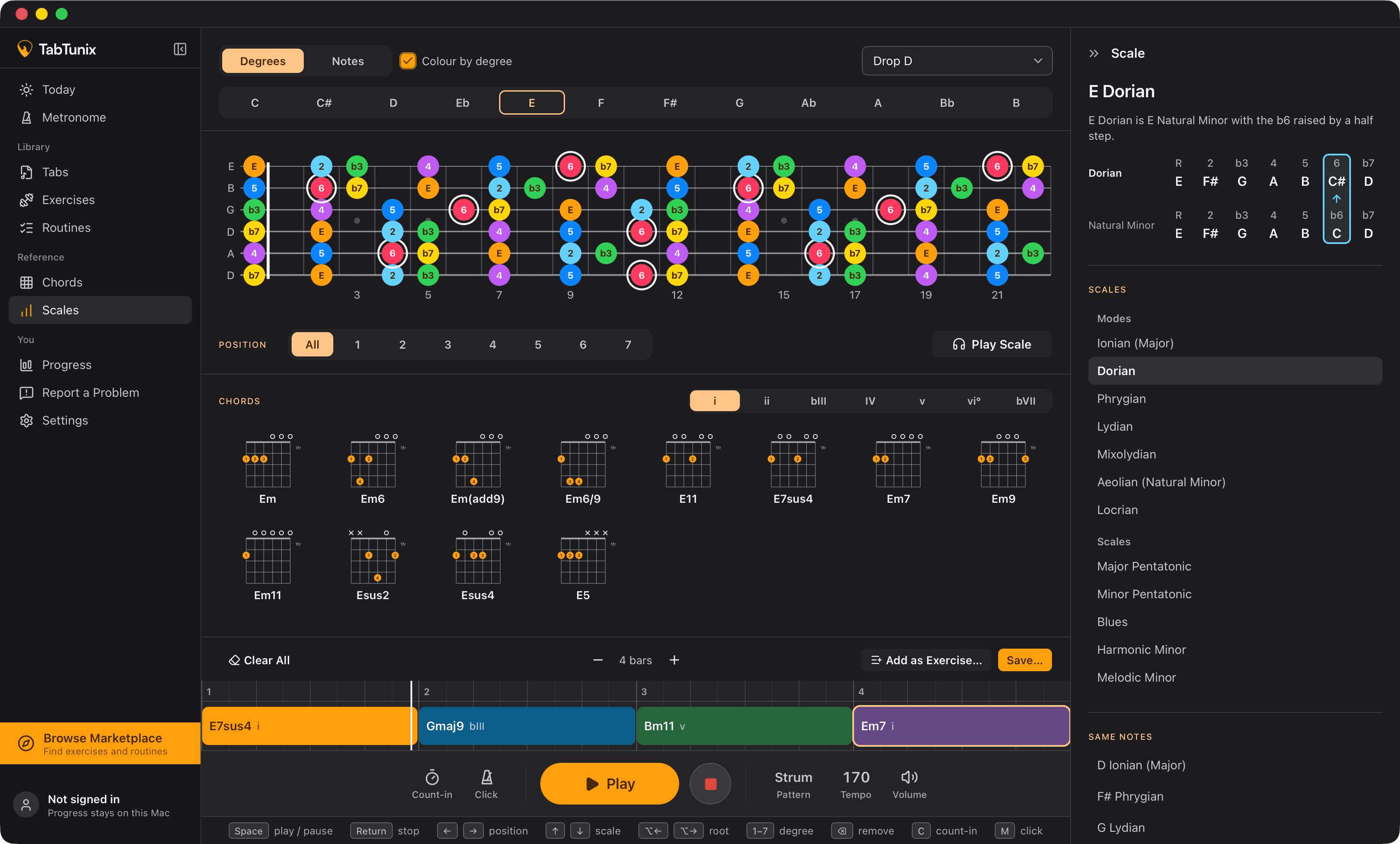
In the free TabTunix app any scale, on any root and in any of its seven tunings, becomes an exercise of its own. Make it from the box you are looking at, and the exercise names it: “Position 1 of 5, frets 5 to 8.”
- Your target tempo, and a click that can climb toward it on its own
- A steady tone on the root under the click, and the scale played once so you hear how it should sound
- Each take rated by you at the tempo you played, and a chart of your takes against the target
- The exercise in your practice routine, with minutes of its own
Make the box you are on an exercise, set a target tempo, and watch your takes climb toward it.
Download for freeQuestions about practicing guitar scales
Practice each box to a click and see your clean tempo rise, take by take. Free, for Mac and Windows.